
Why Large Land Parcels Are Becoming Scarce in India’s Industrial Corridors
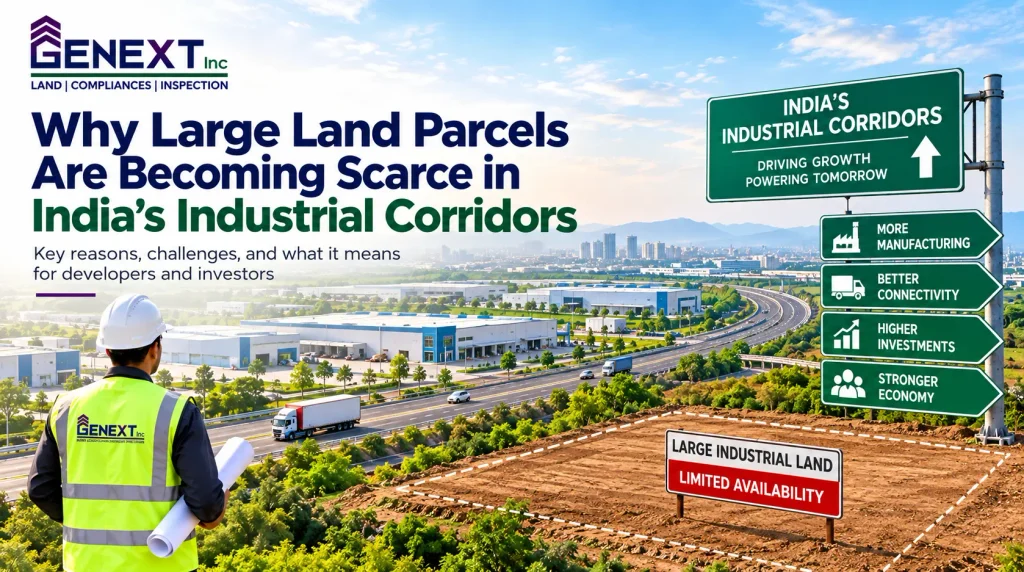
India’s industrial corridors are at the center of the country’s economic transformation. With large-scale investments in manufacturing, logistics, and infrastructure, these corridors are witnessing a surge in demand for industrial land. However, one of the most pressing challenges emerging today is the scarcity of large, contiguous land parcels.
For developers, investors, and corporates planning large-scale projects, this scarcity is not just a land issue—it directly impacts project feasibility, timelines, and long-term scalability.
The Growing Importance of Industrial Corridors
Industrial corridors such as the Delhi-Mumbai Industrial Corridor (DMIC), Eastern and Western Freight Corridors, and various state-led industrial belts are designed to:
- Boost manufacturing output
- Improve logistics efficiency
- Attract domestic and global investments
- Create integrated industrial ecosystems
As these corridors mature, they naturally attract higher demand for land—especially for large-scale industrial parks, logistics hubs, and manufacturing units.
Why Large Land Parcels Are Becoming Scarce
1. Fragmented Land Ownership Patterns
One of the biggest challenges in India is land fragmentation due to inheritance and traditional landholding systems.
Over time:
- Large agricultural lands get divided into smaller parcels
- Ownership spreads across multiple stakeholders
- Negotiations become complex and time-consuming
As a result, assembling large contiguous land becomes increasingly difficult.
2. Rapid Infrastructure Development Driving Demand
New infrastructure developments such as:
- Expressways
- Rail-linked logistics hubs
- Industrial nodes
- Airports and ports
are attracting industries to specific corridors. This has led to a sharp increase in demand for land in limited geographies, quickly absorbing available large parcels.
3. Rise of Industrial and Warehousing Demand
Sectors such as:
- E-commerce
- FMCG
- Manufacturing
- 3PL logistics
require large land parcels for:
- Mega warehouses
- Industrial parks
- Integrated facilities
As demand grows faster than supply, availability naturally declines.
4. Conversion and Compliance Challenges
Even when large land parcels exist, they are often:
- Agricultural in nature
- Not zoned for industrial use
- Located in environmentally sensitive zones
The process of converting and aligning such land for industrial use involves multiple approvals, making it less readily available for immediate development.
Before initiating any industrial land acquisition, businesses should also understand the importance of early regulatory planning. Read our guide on Why Early-Stage Compliance Planning Is Critical for Industrial Projects to learn how proactive compliance can reduce project delays and legal risks.
5. Speculative Land Holding
With rising industrial activity, many landowners and investors:
- Hold large parcels expecting price appreciation
- Delay selling or development
This reduces the supply of readily transactable land in key industrial zones.
6. Competing Land Uses
Industrial corridors are not limited to industrial activity alone. Competing land uses include:
- Residential developments
- Commercial projects
- Institutional spaces
This competition further reduces the availability of large industrial land parcels.
Impact on Developers and Investors
The scarcity of large land parcels has several implications:
- Higher land acquisition costs
- Longer project timelines due to aggregation challenges
- Increased legal and compliance risks
- Limitations on scalability of industrial projects
For large corporates and institutional investors, this can significantly affect site selection and expansion strategies.
Shift Toward Strategic Land Aggregation
To address these challenges, developers are increasingly focusing on:
- Structured land aggregation
- Early-stage land identification
- Corridor-based land banking
- Partnership models with landowners
Aggregation has become a core strategic function, rather than just a transactional activity.
Emerging Trends in Industrial Land Strategy
Due to scarcity, the market is witnessing several shifts:
- Preference for pre-aggregated land parcels
- Growing demand for private industrial parks
- Increased interest in tier-2 and peripheral locations
- Focus on infrastructure-aligned land acquisition
These trends are reshaping how industrial real estate projects are planned and executed.
Conclusion
The scarcity of large land parcels in India’s industrial corridors is a structural challenge driven by fragmentation, rising demand, regulatory complexities, and competing land uses.
For developers and investors, success in this environment depends on early planning, strategic land aggregation, and alignment with infrastructure development.
In today’s industrial real estate landscape, access to large, well-located land parcels is no longer just an advantage—it is a critical differentiator.
Stay updated with the latest insights on industrial land acquisition, land aggregation, infrastructure developments, and industrial real estate trends by following Genext Inc. on Facebook.
