Why Early-Stage Compliance Planning Is Critical for Industrial Projects
Industrial projects in India are becoming increasingly complex, involving multiple stakeholders, large capital investments, and strict regulatory frameworks. While developers often prioritize land acquisition, design, and construction timelines, one critical factor that significantly impacts project success is compliance planning at the early stage.
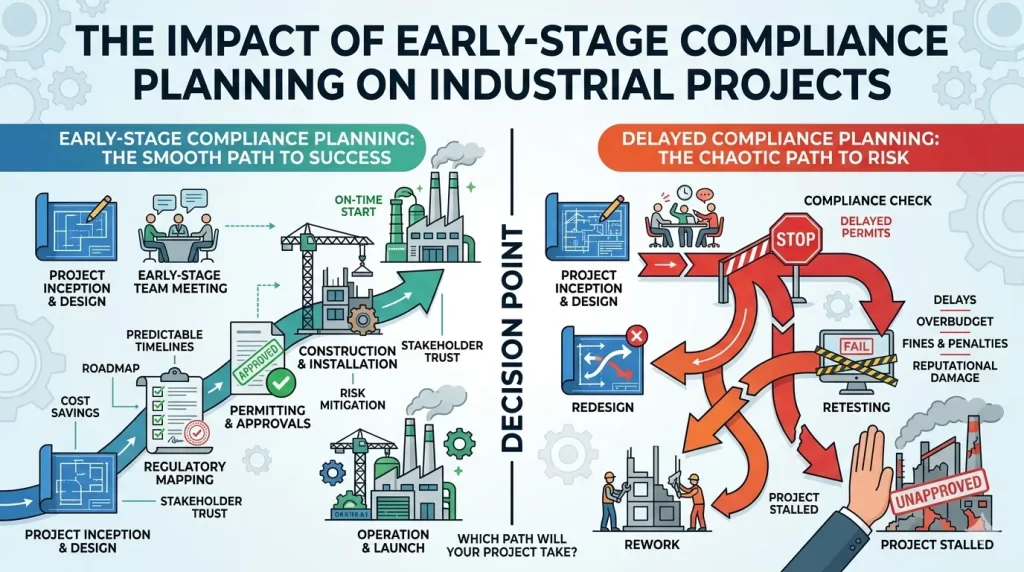
In many cases, compliance is treated as a procedural step after land acquisition or during construction. However, this approach often leads to delays, cost escalations, and operational challenges. Early-stage compliance planning helps align the project with regulatory requirements from the outset, ensuring smoother execution.
What Is Early-Stage Compliance Planning?
Early-stage compliance planning refers to evaluating all regulatory requirements before finalizing land acquisition, design, and project execution strategy.
It involves understanding:
- Land use and zoning regulations
- Approval requirements across departments
- Environmental and pollution norms
- Infrastructure and utility permissions
- Labour and safety regulations
This proactive approach ensures that projects are designed and executed in line with applicable laws.
Why Compliance Planning Must Begin Early
1. Avoiding Land-Related Risks
One of the biggest risks in industrial projects arises from selecting land without proper regulatory evaluation.
Early compliance planning helps:
- Verify zoning compatibility
- Assess feasibility of land use conversion
- Identify restrictions under master plans
- Avoid acquisition of non-developable land
This prevents costly mistakes at the foundation stage of the project.
2. Reducing Approval Delays
Industrial projects require approvals from multiple authorities, such as:
- Town planning departments
- Pollution control boards
- Fire departments
- Utility providers
If compliance requirements are not mapped early, developers may face:
- Repeated application rejections
- Missing documentation
- Sequential delays
Early planning allows for parallel processing and better timeline management.
3. Optimizing Project Design
Compliance requirements often influence:
- Building layout and height
- Fire safety systems
- Environmental safeguards
- Infrastructure planning
When compliance is integrated at the design stage, it reduces the need for redesign or rework later.
4. Controlling Project Costs
Late-stage compliance corrections can lead to:
- Structural modifications
- Additional infrastructure requirements
- Penalties or fines
- Increased consultant and legal costs
Early compliance planning helps control these costs by ensuring everything is aligned from the beginning.
5. Ensuring Faster Project Execution
Projects with clear compliance pathways:
- Move faster through approval stages
- Face fewer interruptions during construction
- Achieve quicker operational readiness
This is especially important for industries with time-sensitive operations.
6. Improving Investor Confidence
Institutional investors and large corporates prioritize:
- Regulatory clarity
- Risk mitigation
- Predictable timelines
Projects with strong compliance planning are seen as more reliable and investment-ready.
Common Mistakes When Compliance Is Delayed
- Purchasing land without zoning verification
- Ignoring environmental clearance requirements
- Underestimating approval timelines
- Treating compliance as a post-design activity
- Lack of coordination between consultants and execution teams
These mistakes often result in avoidable delays and financial losses.
Key Elements of Effective Compliance Planning
1. Pre-Acquisition Due Diligence
Evaluate land from a regulatory perspective before purchase.
2. Approval Mapping
Identify all required approvals and their timelines.
3. Design Integration
Align architectural and engineering plans with compliance requirements.
4. Documentation Readiness
Prepare all required documents in advance to avoid delays.
5. Continuous Monitoring
Track compliance throughout the project lifecycle, not just at the beginning.
Conclusion
In industrial development, compliance is not just a regulatory requirement—it is a strategic function that directly impacts project success.
Early-stage compliance planning enables developers to avoid risks, reduce delays, control costs, and ensure smoother execution. As regulatory frameworks become more structured and stringent, integrating compliance from the very beginning is no longer optional—it is essential.
