Ready-to-Move vs Built-to-Suit Industrial Property: What’s the Difference?
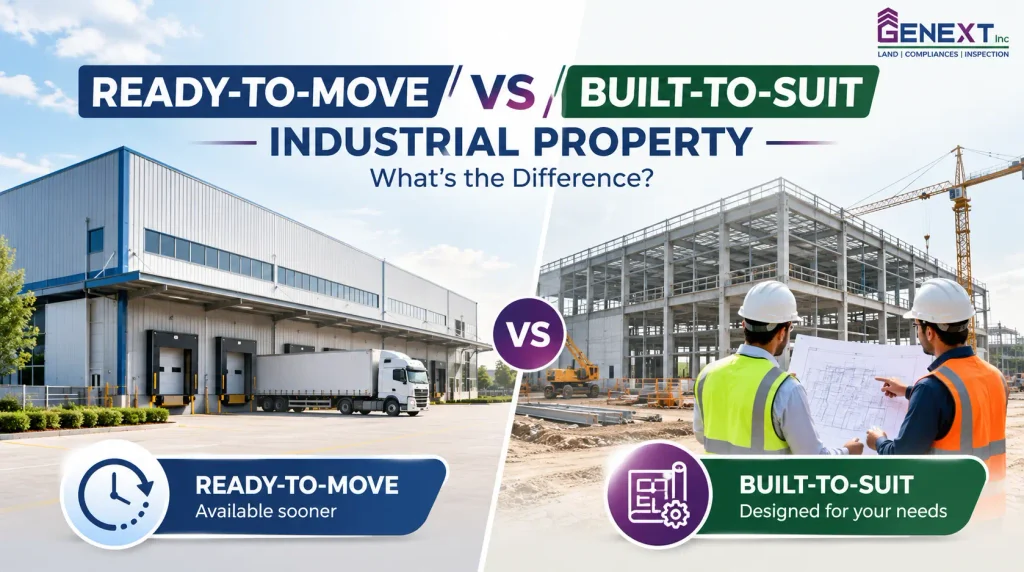
When businesses are looking to establish a manufacturing, warehousing, logistics, distribution, or other commercial enterprise, choosing the right industrial property is crucial for their operational success. There are two types of industrial properties that are commonly available: ready to move industrial and built to suit industrial properties. Both can satisfy business needs but are vastly dissimilar in terms of availability, customability, cost planning, timelines and flexibility.
Recognizing these variations can help businesses choose a property that’s suitable for their requirements and plans.
What Is a Ready-to-Move Industrial Property?
A ready to move industrial property is an industrial facility that is already built and ready for immediate or relatively prompt occupation, depending on the documentation, approvals and facility readiness required.
These properties can be industrial sheds, manufacturing facilities, logistics or other established industrial properties. Business can view the current structure, roads and lanes, utilities, loading areas, parking and surrounding infrastructure before deciding.
The top benefit is that it is fast. For a business that requires operation time right away, it might be better to rent an existing property rather than waiting until it is built.
However, the property will not necessarily be exactly what the company is looking for. Any alteration of the layout, electrical, storage, flooring, loading facilities or other features may necessitate extra investment and approvals.
Before finalising an industrial property, businesses should also understand the applicable regulatory requirements. Read our guide on real estate project approvals businesses should check before starting a project to learn more.
What Is a Built-to-Suit Industrial Property?
Built to suit industrial property refers to a property that is built specifically to the needs of the future tenant or company. The business outlines its needs and a development plan is prepared instead of choosing a facility that has already been completed.
A logistics firm, for instance, might need certain loading bays, circulation space, storage space heights, parking, office space or vehicle movement systems. The needs may vary between various manufacturing firms with respect to manufacturing areas, utilities, storage and internal movement.
Therefore, the development can be built to suit as opposed to the standard ready to move property, which offers greater customisation.
The compromise is that the time is sacrificed. The time to occupy an existing facility is often much shorter than the process of site selection, planning, design, approvals, construction, testing and handover.
Key Differences Between Ready-to-Move and Built-to-Suit Industrial Property
1. Availability and Timeline
The ready-to-move properties are usually quicker to move into as the principal building work is already finished. This can be beneficial for businesses in need of immediate operational needs.
The built-to-suit projects are developed and constructed prior to occupancy. The time frame is subject to the site, design, approval, construction progress and project needs.
2. Customisation
Ready to move homes are less customisable, since the building is already in existence. There may be modifications available depending on the property and the applicable permissions.
Built to suit properties are built to suit the needs of the business; they offer more flexibility in the planning and construction.
3. Cost Considerations
A ready to move property can help to make cost estimating easier as businesses can be able to check out the property and let them know what they need to change right away.
Costs can be associated with built to suit project, depending on the project, the costs can include land, design, approvals, construction, infrastructure, utilities, and project specific requirements. However, the last structure can be designed so that unnecessary features are not provided and the design is more in keeping with the operational requirements.
The real cost savings of either choice will vary based on location, property condition, property specifications, lease or purchase arrangement, construction costs and business time line.
4. Risk and Due Diligence.
Ready-to-move properties enable an existing property to be physically inspected by the business. They should still check for ownership, land use, approvals, building documents, utility access, utility availability, access, compliance, and the physical condition of the property, however.
Due diligence is necessary at a built site and development level of projects. In this regard, businesses must be aware of the issues regarding the land, development permissions, project approvals, construction responsibilities, timelines and specifications, as well as the conditions for handover.
Which Option Is Better for Your Business?
The correct answer is not one and there is no one correct answer. When speed, availability and the visibility of the existing facility is a priority, a ready to move industrial property may be more appropriate.
If there are certain operational needs, long-term planning and facility customisation are more important than immediate occupancy, then a built-to-suit property may be better.
When an investment decision is made, businesses should consider the site, connectivity, suitability of land and property, infrastructure, approvals, budget, operational needs, expansion plans, and projected date of occupancy.
Final Takeaway
The business’s priorities will ultimately determine whether a ready to move or built to suit industrial property is selected. Built-to-suit facilities allow for more features and design controls, while ready-to-move facilities can be achieved more quickly through the pre-existing facility.
Businesses should do proper commercial, legal, technical and regulatory due diligence prior to finalising an industrial property. By carefully making the right decision, unexpected costs, issues with approval, operational restrictions and delays can be minimized and the property can become the right one for the business’ long-term objectives.
For more insights on industrial real estate, land selection, and regulatory compliance, follow Genext Inc. on LinkedIn.
