
Landowner Agreements for Industrial Land Aggregation: Key Clauses to Understand
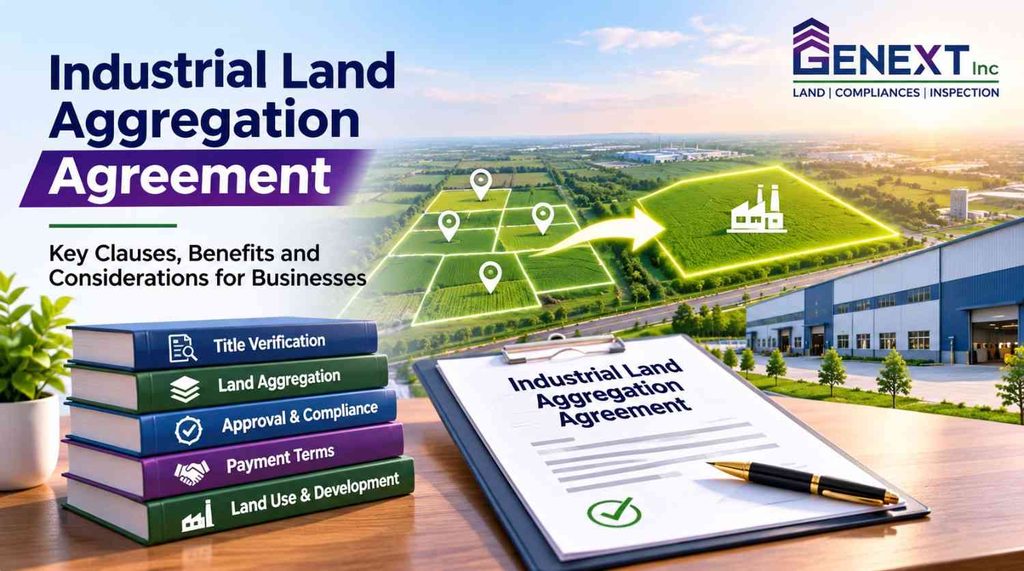
Industrial land aggregation is the process of consolidating several land parcels from various landowners to form a larger and appropriate land area for industrial development. An Industrial Land Aggregation Agreement helps define the terms and conditions between landowners and aggregators. Such a process is necessary for companies that are designing manufacturing facilities, warehouses, logistics parks and industrial facilities.
But when it comes to merging several parcels of land, it’s more than finding the right land. It is important that businesses and aggregators have clear agreements with the landowners to safeguard their interests and prevent legal issues.
The landowner agreement clearly outlines the obligations of the landowner and land manager, financial terms, land use conditions and the transfer of or acquisition of land rights. It’s vital to know its conditions so as to have more transparency and smoother industrial land transactions.
1. Land Ownership and Title Verification Clause in an Industrial Land Aggregation Agreement
Land ownership and title verification clause. An agreement should not be formed until it has been determined that the landowner possesses a valid title to the land. This clause should clearly specify the landowner and detail the nature of the land such as its location, khasra numbers, area and related revenue records.
Some of the more important documents can be:
- An application on a standard format for registration of sale deed/ownership documents
- Records of assignment of land and mutation records
- Clear the details of Khasra & Khatauni (if applicable),
- The documents of succession or inheritance (if applicable)
Also, the agreement must also reveal if the land is jointly owned or if there are any ownership issues. Consent of all relevant co-owners must be given.
2. Land Area and Parcel Identification Clause in an Industrial Land Aggregation Agreement
A lot of times, industrial land aggregation will require a number of parcels held by various personal owners. Thus it is crucial to correctly identify each parcel.
The terms and conditions of the agreement should include exact area, boundaries, khasra numbers and location of each parcel of land.
It should also indicate whether the agreed area is from revenue records or a survey of the area. If there is any discrepancy between the recorded and measured land area, this should be resolved prior to finalisation of the transaction.
This clause can be useful to avoid boundary issues or conflict on consolidation.
3. Exclusivity and Non-Transfer Clause in an Industrial Land Aggregation Agreement
An exclusivity clause safeguards the aggregator’s interest in the negotiation or aggregation period.
This is a covenant that the landowner is not allowed to go back to a different buyer, broker or aggregator for the same land within the duration indicated.
The agreement should clearly mention:
- Exclusivity duration
- Conditions for extension
- Restrictions on selling or transferring the land
- Consequences of violating the agreement
Yet, do not consider exclusivity as if it is a form of ownership or as a right to automatically buy the property.
4. Payment Terms and Consideration Clause in an Industrial Land Aggregation Agreement
Do you like this personality?
One of the most crucial components of a landowner agreement is payment terms. This clause provides for the amount to be paid to the landowner and the timing of the payment.
It is important that the agreement makes it clear that:
- Total agreed land value or consideration
- Advance payment or token amount
- Payment milestones and deadlines
- Mode of payment, preferably through traceable banking channels
- Conditions for refund or adjustment of advance payments
Straightforward payment conditions minimise payment misunderstandings and payment conflicts.
5. Land Use and Approval Conditions in an Industrial Land Aggregation Agreement
Not all land in agriculture or used for purposes other than agriculture is suitable for industrial use. Before any further steps are taken, the land use permissions, zoning regulations and applicable government approvals should be looked at.
Both the parties should take into consideration the land use framework applicable, including Change of Land Use (CLU) provisions where applicable, in industrial projects undertaken in Haryana.
The agreement should specify:
- Existing land-use classification
- Liability for obtaining necessary approvals
- Landowners need to cooperate
- Conditions when the proposed industrial use is not allowed
- Accountability regarding expenses of the approval process
It is important to note that an agreement with a landowner does not give automatic “permission” to use the land for an industrial purpose nor does it secure government approval.
6. Possession and Access Rights Clause in an Industrial Land Aggregation Agreement
To prevent disputes in the land aggregation, the possession related conditions need to be clearly expressed.
This clause should define the time of transfer, if available, or if not, with conditions, when the possession will be transferred, whether the property will be empty or under the possession of some other parties, and what the rights of access will be.
Should also explain:
- The existing tenants or occupants of the premises.
- Roads and gates to access site.
- Encroachments or boundary problems
- The existing structures and utilities have been conserved.
- Ownership over the land prior to handover
Road connectivity and access are especially critical for warehouse or manufacturing projects. Businesses planning to lease industrial property should also evaluate important factors such as location, accessibility, infrastructure and legal documentation. Read our guide on What Businesses Should Check Before Leasing an Industrial Property for Lease to understand the key considerations before making a leasing decision.
7. Indemnity and Liability Clause in an Industrial Land Aggregation Agreement
Indemnity clause: This clause safeguards the parties against certain types of losses resulting from a failure to work up to contract conditions or hidden problems.
In a situation where there is an existing ownership dispute or mortgage, for instance, if the landowner does not inform the other party, the agreement should spell out what the landowner is liable for in terms of losses, in accordance with the applicable law.
Likewise, the duties of the aggregator should be stipulated.
The agreement should include un-disclosed liabilities, false ownership representations, breach of agreed conditions and third party claims.
8. Clause on termination and resolution of disputes
All landowners contracts should state under what circumstances either party may end the contract.
Some typical termination conditions are:
- Not paying agreed payments on time
- Some serious title defects were found.
- Lack of key approvals within the agreed time frame
- Failure to live up to contractual requirements.Non-observance of contract requirements.
- Mutual agreement to terminate
In addition, the agreement should include a dispute resolution mechanism, such as arbitration process or applicable court jurisdiction, if applicable.
9. Registration, Stamp Duty and Documentation
Agreements relating to property are not necessarily legally valid or enforceable because of their nature, form and the requirements for their registration and stamp duty.
The transfer of property act 1882, section 54 provides that a contract of sale does not convey ownership or an interest in immovable property per se. A registered conveyance deed typically is needed for a sale of immovable property. Also, the Registration Act, 1908, Section 17, lists of documents that must be compulsorily registered.
Therefore, parties should seek legal advice about what type of agreement to enter into and which stamp duty and registration is required before entering into the agreement.
Conclusion
To achieve successful industrial land aggregation, a well-designed landowner agreement must be in place. It safeguards owner’s rights, clarifies any payments and reduces the risk of legal issues. Before the industrial land acquisition process, businesses and aggregators must make sure that every parcel is verified independently and that all of the contractual obligations are well documented.
In Delhi NCR and Haryana, due diligence by professionals and effective documentation can help to fortify the industrial land development process with greater security. Follow Genext Inc. on LinkedIn for the latest updates, insights and guidance on industrial land aggregation, real estate approvals and compliance consulting.
