
Building Occupancy Certificate: Why It Matters for Commercial Property Owners
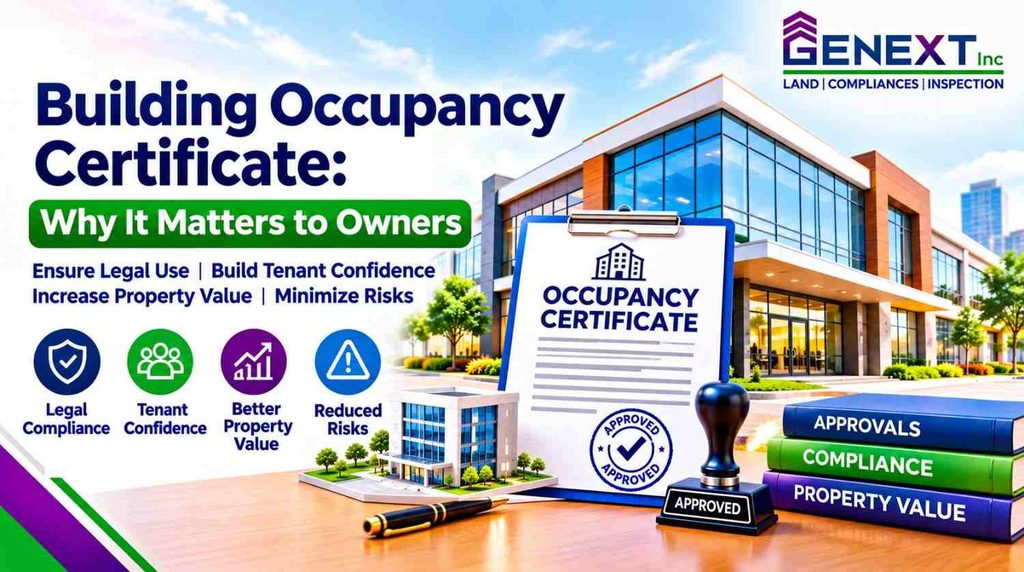
Once a commercial building is built does not necessarily mean it is legal to use. It is the owner’s responsibility to get the necessary Building Occupancy Certificate (OC) from the competent authority prior to commencing operations or hosting tenants. It certifies that the structure (or part of the structure as approved) was built in accordance with the approved plan and regulations.
An OC provides legal cover and mitigates regulatory concerns.
What Is a Building Occupancy Certificate (OC)?
An OC is an official document issued by the relevant local or development authority, following the consideration of prescribed completion documents and checks. It attests to the fact that the building complies with the conditions of the permission for occupation.
Its issuing authority might vary according to location; for example, it could be a municipal corporation or a development authority. An OC is not the same as a building plan approval, which allows you to construct, and a completion certificate, which documents construction completion. The process varies, depending on state and local rules.
An Occupancy Certificate is important for what reasons?
1. Confirms Lawful Occupation with a Building Occupancy Certificate
An OC defines conditions where it is acceptable to occupy premises as per applicable building regulations. The occupation-certificate process is described in the Haryana Building Code, 2017 (as amended) in Haryana. A new building or part of a building should not be used until a competent authority certifies its completion and issues an OC in accordance with its general procedure. Verify the process for building type.
2. Builds tenant confidence
Commercial properties are desired by companies for offices, retail spaces, showrooms or warehouses which are legally compliant and ready for use. A Building Occupancy Certificate (OC) is an essential document to examine during the due diligence process by potential tenants, as well as for transparency in the leasing process. Owners should check that a certificate extends to the specific premises that they are selling in either units/phases or separate floors.
3. Supports resale and property value
When purchasing commercial real estate, buyers and their legal counsel typically check out sanctioned plans, completion records, and the OC. Lack of or unclear approval may result in questions, delays, negotiation problems or corrective needs. By having a valid OC, it shows that the building has gone through the appropriate occupation process. Not a clear title document; the buyer is still required to do legal and technical due diligence.
For businesses and investors planning to purchase commercial or industrial properties, understanding legal documentation and regulatory approvals is an important part of investment planning. Read our guide on Industrial Investment in India: Long-Term Returns to understand the key factors that influence industrial property investment and long-term value.
4. Reduces regulatory and financial risks
Not complying with the requirements for approval to occupy a building may lead to a notice, penalty, restriction or other action under applicable law against the owner or occupier. Any changes to the approved plan may postpone approval. Not all deviations are “compoundable” and some may need to be “corrected.
5. Supports safety and building services compliance
Part of the OC process will include reviewing completion drawings, site information and relevant clearances. Depending on building and local rules, documents could comprise fire-clearance, professional completion certificate, and energy-related compliance. It is not a substitute for routine Fire System maintenance or Fire Safety inspections.
What Documents Are Required for a Building Occupancy Certificate?
Requirements are site dependent, building use dependent, height dependent, risk category dependent and authority dependent. Typically requested documents include:
- Approved Building Plans and/or Building Plan changes.
- Completion drawings and/or prescribed completion certificate.
- Details of deviations from the approved plan.
- Applies to fire-safety NOC or clearance.
- Where necessary, relevant structural, electrical, environmental or departmental clearance to be provided.
- Prescribed application forms, photographs, permission records and fees.
This is a guide only – check with the competent authority for current requirements.
Practical Steps for Commercial Property Owners
Make a comparison between the finished building and the most up to date sanctioned plan. Engaging the architect to verify deviations and to create as-built drawings. Request any clearances necessary for the use and site of the property and file the required application and attach the supporting documents. Follow the directions of their authority/observations and keep OC/approvals.
When purchasing or leasing, check the OC with the issuing authority. Review property address, building, unit or phase covered including conditions and issue date. Don’t just take the word of the photocopy or word of mouth.
Conclusion
One of the most important compliance documents for commercial property owners is a Building Occupancy Certificate. It assists in establishing that a building has gone through the necessary approval process before it is occupied, it aids in the leasing and resale process it is due diligence and it minimizes avoidable legal and financial risks. Due to variations in requirements between jurisdictions and building type, owners must check the rules that are relevant to their premises and apply for the right certificate.
When occupying, leasing and purchasing of commercial properties in Haryana, please check the latest Haryana Building Code and competent authorities. Follow Genext Inc. on Instagram for the latest updates on industrial real estate, commercial property, regulatory compliance, building approvals and property insights.
