Real Estate Compliance Checklist for Businesses Expanding to a New Location
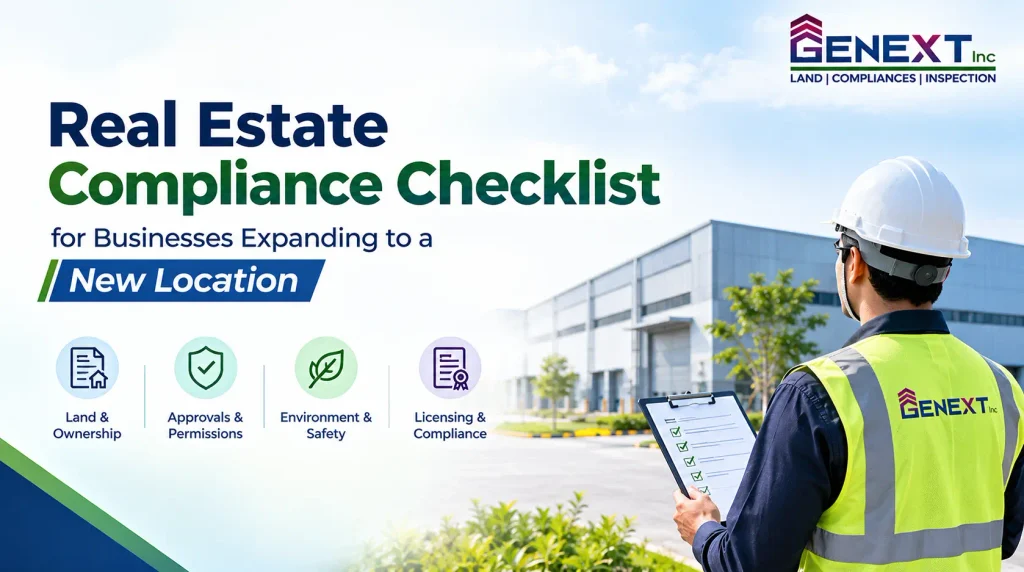
While price, size, and connectivity are crucial factors to consider when choosing a property location for expansion, a real estate compliance checklist is equally important. Additionally. it is important that the proposed business activity and building construction meet local authority, environmental, safety, legal, and zoning requirements.
Different States, categories of properties, business activities, nature of the project have different requirements for compliance in India. Different permits might be necessary for a warehouse, manufacturing plant, office, and commercial building. By following a real estate compliance checklist before buying, leasing, or developing real estate, businesses can minimize legal risks, avoid unnecessary delays, and ensure they are making informed investment decisions.
1. Verify Land Ownership and Property Title in Your Real Estate Compliance Checklist
Check the ownership and legal title before finalising a property. Businesses should examine the registered sale deed and previous ownership documents. They should also review land records to confirm the seller’s legal authority to transfer the property.
In addition, examine any existing mortgages, liens, litigation, acquisition notices, easements or other encumbrances which may impact the ownership or use of a property. Have a qualified property lawyer provide you with an appropriate title search and legal due diligence report.
In the case of industrial land, agricultural land or large land parcels additional checks may be required to verify that the land is being used as allowed and that there are no restrictions on transfer or development.
2. Confirm Land Use and Zoning Permissions in Your Real Estate Compliance Checklist
A property appropriate for one use may not be appropriate for another use. Businesses must confirm whether the proposed site is suitable for their intended activity. Check the relevant master plan, development plan, zoning rules, and industrial estate regulations.
For instance, a manufacturer can’t just build on land that is zoned for residential use. Likewise, if the land is used for agriculture or is to be converted to agriculture, Change of Land Use (CLU) may be needed (if applicable).
Before investing in an activity, development, building coverage, setbacks, floor area requirements and planning conditions, confirm the activity, restrictions on development, building coverage, setbacks, floor area requirements and planning conditions.
3. Check Building Approvals and Occupancy Documents in Your Real Estate Compliance Checklist
Where a business is considering the purchase or lease of an existing building, it is important to check that it was built in line with approved building plans and applicable regulations.
Required documents vary depending on the property and local regulations. These may include sanctioned building plans, building permits, completion certificates, and occupancy certificates.
If you are developing a new building, please see the building plan approval process before you start building. Don’t presume compliance because a building is in use or working.
4. Obtain Environmental Clearances and Pollution Approvals in Your Real Estate Compliance Checklist
Manufacturing units, warehouses and industrial projects require special attention for compliance with the environment. For Australian businesses, Environmental Clearance (EC), Consent to Establish (CTE) or Consent to Operate (CTO) will be required depending on the type of project, its capacity, location and activities.
Wherever applicable, CTE and CTO are issued by the concerned State Pollution Control Board/Pollution Control Committee. Projects subject to the relevant environmental laws and policies may need to go through an environmental clearance process. Check on the official PARIVESH portal and State Department.
5. Review Fire Safety and Building Infrastructure in Your Real Estate Compliance Checklist
When moving into a property, inspect fire safety measures, emergency exits, evacuation routes, electrical systems and fire fighting equipment.
Fire NOC or other fire safety approvals may be necessary depending on type of building and applicable rules. Industrial plants should also conduct a structural stability analysis, ventilation, drainage, water supply and emergency access analysis.
Verify the building’s structure and system meet the requirements of the business and safety equipment is in place and in good working order.
6. Check Electricity, Water, and Access Permissions
A building’s facilities should be suitable for the enterprise. Verify the authorized electric load, water supply, sewage facilities and access for employees, customers, and business vehicles.
For some industrial installations, extra electricity load approval, transformer installation permission or approvals may be required for diesel generator sets based on the configuration and relevant regulations.
In the case of industrial land, ensure that there is legal road access and any necessary highway access permissions. Evaluate truck, loading bay and future expansion requirements for site.Businesses planning industrial warehouse projects should also understand the electrical scheme approvals for industrial warehouse projects to ensure that the required electrical infrastructure and permissions are addressed before starting operations.
7. Verify Business-Specific Licences and Registrations
Not all business activities are permitted to be done under the property compliance. There may be other permits or licenses that will be needed for the manufacturing units and other permits may be needed for specific activities.
Requirements vary for the business, such as a factory licence, trade licence, Shops and Establishments registration, fire safety approval or sector-specific permissions. For instance, food businesses need to carry out the applicable FSSAI licensing requirements assessment.
Determine type of approvals before commencing operations. The Know Your Approvals facility is available on the National Single Window System for businesses to determine the applicable central and state approvals.
8. Review Lease Agreements, Taxes, and Legal Obligations
In the case of leased buildings, check the lease or leave-and-licence document. Review allowed uses, lease periods, rent increases, security deposit, tenant maintenance obligations, lease renewal, lease termination and tenant approval requirements.
Check if the agreement needs to be registered under the relevant legislation. Check property tax, any outstanding utility bills, stamp duty and registration fee.
If purchasing a property, ensure that all the terms have been agreed and that all documentation is in order and that all payments and registration are completed.
Conclusion
Real estate compliance should be a priority when expanding a business to a new location. Preventing avoidable legal and operational issues can be achieved by verifying ownership, land use, building approvals, environmental, fire safety, infrastructure and business licences.
Prior to signing a purchase agreement or lease, develop a compliance checklist specific to the location. Ensure that you seek advice from the right legal and technical experts and double-check with the appropriate authorities. A compliance review with a structure will enable any business to make informed property decisions, set realistic timelines and plan to operate on a solid legal base.
For more insights on industrial real estate, property approvals, and regulatory compliance, follow Genext Inc. on LinkedIn for the latest industry updates, business insights, and professional guidance.
