What Is Green Belt Policy in India? Types, Importance, Approvals & Rules
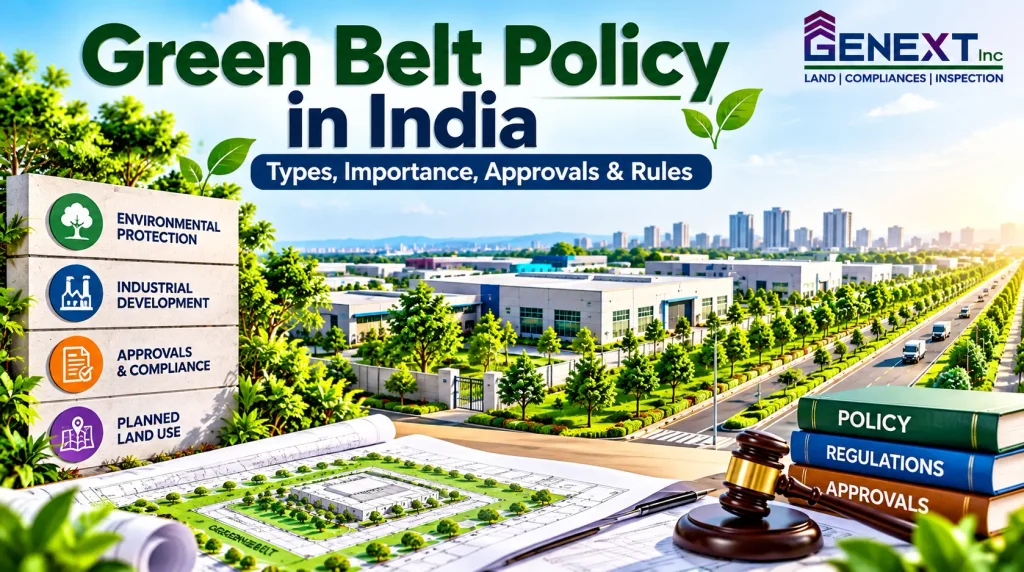
Green Belt Policy in India has an important role in the planned development, environmental protection, industrial projects, and land-use planning. A green belt is typically a designated or planted area of trees, plants, shrubs, and other plant life that separates land uses and minimizes the impacts of development.
Green belt requirements may vary according to the development plan, zoning requirements, environmental conditions, project type and approvals needed for the specific project location for industrial and real estate projects.
Green belt requirements may vary according to the development plan, zoning requirements, environmental conditions, project type and approvals needed…
What Is Green Belt Policy in India?
The Green Belt Policy in India, is a planning and environmental policy that involves the designation or development of areas as green/open spaces for ecological and planning purposes.
- A green belt can be put in place for a number of purposes:
- Minimising the dust and air-pollution effects
- Providing vegetation cover
- Enhancing the visual environment.
- Creating a buffer between industrial and other land uses
- Supporting biodiversity
- Assisting in the reduction of noise and windborne pollutants.
- Improving the overall environmental quality of a project area.
Most important of all is that there is no single rule for all properties or industries in India that is green-belt. Requirements may be derived from various planning and environmental documents.
How Many Types of Green Belt Are There?
Based on the purpose of the green area, the Green Belt Policy in India can be classified practically in various categories.
1. Industrial Green Belt
Industrial green belts are designed around or within an industrial project to fulfill the environmental buffering and vegetation cover functions. The need may vary according to the pollution potential of the industry and the environmental condition.
2. Development Plan Green Belt
The creation of a green belt might also be included in the city’s development plan, master plan, zoning plan or land-use plan. In such instances, the designation is mostly associated with spatial planning and allowed use.
3. Roadside Green Belt
Plantations and landscaped green areas can be established along development corridors, highways and major roads. They may contribute to enhance the visual context and offer a vegetation buffer.
4. Ecological or Environmental Green Belt
Some areas may need protection or vegetation due to environment sensitivity, water bodies, protected areas or other ecological reasons. The necessary environmental notification or planning framework will govern the requirements of such.
Why Is Green Belt Important?
The Green Belt Policy in India is crucial because the activities of development can cause dust, emissions, noise, heat, etc., which are harmful to the environment.
A well-designed green belt can assist:
- Remove dust and particulates
- Minimize the transport of wind blown pollutants
- Enhance local Micro-environment.
- Attach a birdhouse or insect hotel to your tree to create habitat for birds and insects.
- Enhance the look of industrial and commercial areas
- Provide separation of incompatible land uses
- Assist in achieving sustainable development goals
For example, the environmental documents of industrial projects may include detailed plantation plans, including species, plantation density and area of green belt.
Who Approves Green Belt Requirements?
The authority is calculated based on the reason for the need of a green belt.
Under the applicable planning authority (Town and Country Planning/Development) the designation of an area as green belt, open space or other planning controlled land-use will be decided on land-use and planning matters.
The Haryana State Pollution Control Board (HSPCB) regulates Consent to Establish (CTE) and Consent to Operate (CTO) for applicable pollution-control requirements in Haryana. For a detailed explanation of these approvals, see our guide on CTE and CTO Pollution Control Board approvals. In applications for tree plantation/green-belt development, information is also required relating to the development of tree plantation/green-belt.
Green-belt conditions may be part of an Environmental Clearance (EC) provided a project needs to be approved under this classification. Environmental, forest, wildlife and CRZ clearance processes, involving the relevant authorities, are done with the help of the PARIVESH system.
Who Makes the Green Belt Policy?
In India, there is no central government authority for all situations that creates the Green Belt Policy.
The Ministry of Environment, Forest and Climate Change (MoEFCC) at the central level prescribes environmental framework and the conditions for Environmental Clearance. CPCB also offers technical advice with respect to development of the green-belt.
Planning authorities have the ability to set land-use and zoning requirements at state and local levels in development plans, master plans, zoning plans and through other applicable planning requirements.
As such, there is no fixed requirement and the specific requirement needs to be verified with the project location, project type, development plan and relevant approval.
Is There a Policy Where Green Belt Is Not Mandatory?
Yes but this needs an important clarification.
It is not a standard rule that green belts at any time are not required. Rather, the requirement may vary from project to project, and rules to rules.
In October 2025 MoEFCC had issued an Office Memorandum on rationalization of green-belt/green-cover norms of industrial estates, parks and individual industries on pollution potential. In most sectors, green-belt requirements were earlier prescribed by ECs and in some cases in highly polluted areas, higher requirements may apply for some highly polluting industries.
Thus, the green-cover amount may vary or be less for some projects that have low pollution levels, compared with projects with high pollution levels. But, green belt is not a luxury that can be taken for granted for a project. The following conditions of each EC, state pollution control, zoning and development plan should be verified.
Conclusion
Green Belt Policy in India is one of the essential components of environmental management and planned land use. Green belts may be applied to buffering for industries, development planning, roadside plantation and ecological protection.
In the case of an industrial or real-estate project, the need should be confirmed prior to land acquisition or development. The appropriate development plan and zoning provisions, pollution category, Environmental Clearance conditions and state-specific regulations should all be considered.
For instance, in Haryana, the policies of HSPCB with regards to consent and siting also must be adhered to and environmental approvals could include the relevant central or state government if applicable.
Hence, compliance with green-belt is a project specific approval and planning requirement and not assuming compliance with a percentage or a rule based on an assumption that one percentage or rule would be applicable to all projects in India.
For updates on real estate approvals, environmental compliance, land-use regulations and industrial project requirements, follow Genext Inc. on LinkedIn.
