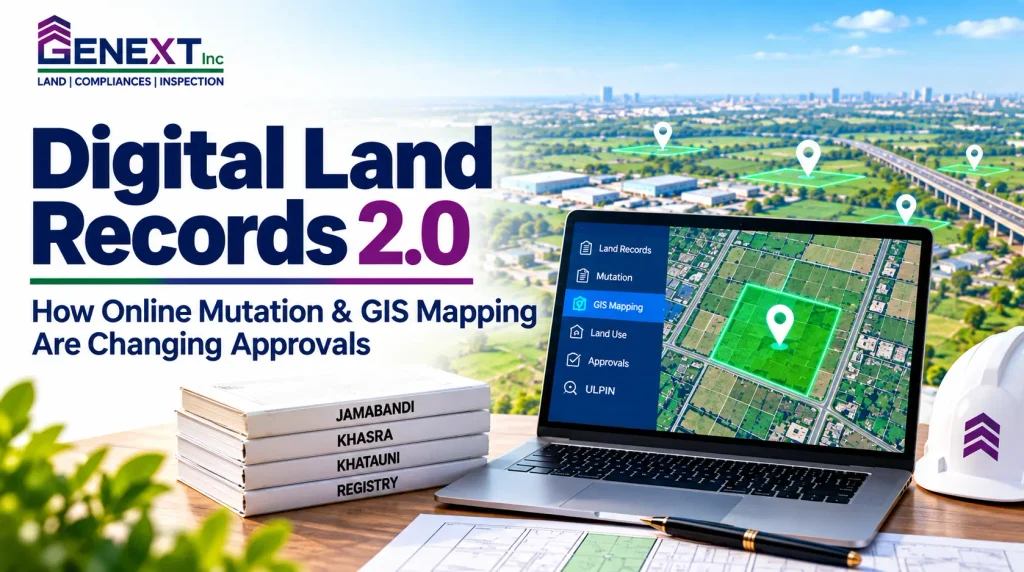
Digital Land Records 2.0: How Online Mutation & GIS Mapping Are Changing Approvals
Land governance in India has undergone remarkable transformation over the last decade, shifting from fragmented manual processes to structured, technology-driven systems. With the rollout of Digital Land Records 2.0, states are moving toward a unified and transparent land management ecosystem using online mutation, GIS-linked land databases, and digitized approval workflows.
This transition is especially significant for industrial, warehousing, commercial, and institutional projects, where land-related approvals often determine project timelines, viability, and investor confidence. This article explores how Digital Land Records 2.0 is reshaping approval mechanisms and simplifying the real estate development process.
1. The Evolution: From Manual Records to Integrated Digital Systems
Historically, land records across India—Jamabandi, Khasra, Khatauni, and Registry—were maintained on paper at the tehsil level. This led to:
- Frequent discrepancies between departments
- Delays in mutation and ownership verification
- Challenges in establishing clear title
- High dependency on intermediaries
- Limited transparency in land approvals
Digital Land Records 2.0 aims to eliminate these bottlenecks by building a single-source, geospatial, tamper-proof land information ecosystem.
2. Key Components of Digital Land Records 2.0
a) Online Mutation (Digital Jamabandi Updates)
Mutation—the process of updating ownership details after a sale, inheritance, or transfer—has historically been slow and manual.
Under Digital Land Records 2.0:
- Applications can be submitted online
- Automated verification using Aadhaar-linked identities
- Faster validation through digitally integrated registries
- Real-time status tracking
- Auto-updation in revenue records upon registry completion
For buyers, industries, and developers, this reduces the risk of litigation and approval delays.
b) GIS-Based Land Mapping
One of the most transformative upgrades is the integration of Geographic Information System (GIS) mapping into land records.
GIS mapping enables:
- Precise land boundary verification
- Overlaying land use, zoning, and CLU restrictions
- Identifying encroachments and disputed areas
- Accessing topography, flood zones, and environmental buffers
- Faster feasibility checks before land acquisition
For industrial and warehousing developers, GIS mapping drastically reduces due diligence time and cost.
c) Unique Land Parcel Identification Number (ULPIN)
Often called “Aadhaar for land,” ULPIN assigns a 14-digit unique ID to every land parcel.
Benefits include:
- Uniform tracking across state departments
- Simplified approvals across revenue, town planning, and pollution boards
- Reduced duplication and fraud
- Clear identification for investors and lenders
d) Integration Across Departments
Digital Land Records 2.0 enables interoperability between:
- Revenue Department
- Town & Country Planning
- Urban Local Bodies
- Environment, Forest & Wildlife Departments
- Pollution Control Board
- Industrial Development Authorities
This integrated ecosystem forms the backbone of faster digital approvals.
3. How Digital Land Records 2.0 is Transforming Approval Processes
a) Faster CLU (Change of Land Use) Approvals
CLU approvals now rely on GIS-based verification of:
- Existing land use
- Zoning compliance
- Buffer zones (roads, railways, canals, forests)
- Environmental restrictions
Automated checks significantly reduce processing time.
b) Streamlined Project Registration & Due Diligence
Authorities can instantly verify:
- Ownership history
- Encumbrances
- Mortgage records
- Previous transactions
- Lease or acquisition rights
This reduces disputes and helps buyers validate land quickly.
c) Easier Environmental & Infrastructure Clearances
GIS layers provide authorities with immediate access to:
- Wetlands and eco-sensitive zones
- Water bodies and drainage paths
- Forest boundaries
- Pollution zones
- High-tension line corridors
With accurate spatial data, feasibility decisions become faster and more transparent.
d) Enhanced Transparency for Investors & Industries
For industrial parks, logistics hubs, manufacturing clusters, and large infrastructure projects:
- Land parcels can be assessed digitally before site visits
- Transaction risks reduce significantly
- Approval predictability improves
- Investors gain confidence due to reduced ambiguity in land titles
However, digital land verification should be complemented with physical site inspections to identify compliance gaps that may not be visible in online records.
4. How Real Estate Developers Benefit
Reduced Approval Timelines
Online verification and automated workflows shorten timelines for:
- Mutation
- CLU
- Building plan approvals
- NOCs
- Consent to Establish / Operate
Lower Due Diligence Costs
With GIS and digital records, physical surveys reduce drastically.
Improved Project Viability
Better land clarity reduces the chances of litigation, disputes, and cost overruns.
Easier Access to Finance
Clear digital land titles improve lender confidence.
5. Challenges in Implementation
While Digital Land Records 2.0 is promising, certain challenges remain:
- Digitization quality varies by state
- Legacy disputes still require manual resolution
- GIS accuracy depends on updated satellite data
- Integration across departments is still evolving
- Rural and peri-urban records often require physical verification
However, reforms are progressing rapidly, especially in industrially active states such as Haryana, Punjab, UP, Rajasthan, and Maharashtra.
Conclusion
Digital Land Records 2.0 marks a pivotal shift in India’s real estate and industrial development ecosystem. By integrating digital mutation, GIS mapping, and inter-departmental workflows, the system brings unmatched transparency, speed, and predictability to land-related approvals.
For developers, businesses, and policymakers, this is more than a technological upgrade—it’s the foundation for faster, fairer, and more efficient land governance.
For more insights on land compliance, approvals, due diligence, and industrial real estate, follow Genextinc on LinkedIn.
