How to Protect Your Investment Through Agricultural Land Acquisition
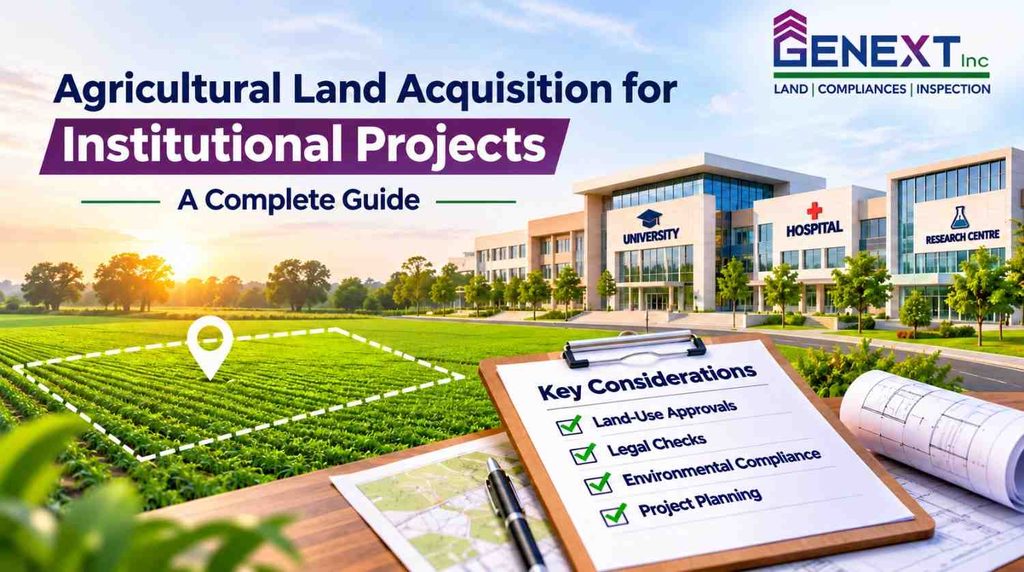
The planning of land for institutional projects like universities, hospitals and research centres is important. Agricultural Land Acquisition may provide access to larger tracts of land, but purchasing agricultural land does not guarantee institutional construction. Additionally, the land must be suitable for the site based on the ownership, land use and environmental and infrastructure considerations.
Understand the Project Requirement for Agricultural Land Acquisition
Identify the need of the institution, its capacity and long-term requirements. For example, Approximate the land requirements for buildings, roads, parking, utilities, green areas, safety setbacks and expansion. A university might require hostels facilities, a hospital might need emergency access and waste-management system. As a result, have a realistic plan, then there will be no unnecessary costs.
For large-scale institutional developments requiring multiple land parcels, understanding the land aggregation process can help businesses evaluate suitable acquisition strategies. Learn more about Industrial Land Aggregation vs Buying One Large Plot before finalising your land procurement approach.
Check Ownership and Land Records for Agricultural Land Acquisition
Check sale deed, ownership documents, revenue documents, mutation, khasra/survey numbers, maps and land registers before signing. Check for transferable rights and for correct boundaries.
Furthermore, Look up mortgages, court cases, notices of acquisition, family disputes, tenancy rights, easements and claims of third parties. Check any access roads that have been recorded and each co-owner’s share and authority to sell. Therefore, don’t rely on mutation as proof of title; have it reviewed by a lawyer.
Verify Zoning and Land-Use Permissions
Land purchased for agricultural use is not suitable in general for an institutional campus. However, the proposed use shall be consistent with the appropriate master plan, development plan, and zoning regulations and state land laws. Prior to construction or use for purposes other than agriculture, conversion or change-of-land-use may need to be granted by the competent authority at the location.
Identify areas restricted, green belts, controlled areas, forests, floodplains and other regulated areas. Identify building rules, development charges and approval processes. Requirements vary from state to state, so ask for written information from planning and revenue officers.
Understand Acquisition and Consent Requirements for Agricultural Land Acquisition
If the government is acquiring land for a qualified public purpose, the provisions of the Right to Fair Compensation and Transparency in Land Acquisition, Rehabilitation and Resettlement Act, 2013 may be applicable (subject to the scope of the said act and applicable State amendments to it). Some of the processes outlined in the Act involve Social Impact Assessment, public consultation, compensation and rehabilitation and resettlement. Applications will be accepted based on the authority of the acquiring authority, project type and statutory requirements.
Private purchase is different from the compulsory purchase. Not all private institutional projects are deemed to be public purpose projects under the Act and therefore not all sales shall have consent provisions. Get a legal opinion on transaction structure, and state and local restrictions such as agricultural land ownership/transfer rules.
Assess Physical and Environmental Suitability
Prior to completion of the land, perform a site inspection and undertake technical due diligence. Examine soil conditions, slope, drainage, groundwater availability, flood history and waterlogging risks. Examine road connections, public transport, electricity, water supplies, sewerage, emergency services and internet. Establish that the site is capable of supporting operations for a minimum capital investment.
Locate the local water bodies, forest, Safety and security area, heritage sites and ecologically sensitive areas. Whether environmental clearance or other permissions are required depends on project size, type and location. Biomedical-waste and sewage disposal systems, fire safety and pollution-control systems may be needed at hospitals and laboratories. Specialist assessments should provide confirmation of applicable approvals.
Ensure that the institution is affiliated with, accredited or licensed (as applicable) by the institution and that all these are separate from land use approval. Work out the layout of the site in relation to the relevant fire, access, sanitation and building-safety codes long before plans are presented.
Plan Costs, Timelines and Stakeholder Engagement
Don’t forget to budget for stamp duty, registration, legal and survey fees, conversion and development costs, infrastructure, site preparation and approvals. Be ready for delays and unexpected circumstances. Create an approval timeline for team, document and dependency.
Involve landowners, cultivators and communities at the outset. Outline the project, listen to concerns and make notes on agreements. Adhere to consultation, compensation and rehabilitations procedures where acquisition law is applicable.
Use a Due-Diligence Checklist
If you are considering investing, check:
- Clear and marketable title, ownership shares and encumbrances.
- Accurate boundaries, access rights and land measurements.
- Allowing institutional use and requiring conversion approvals.
- Development restrictions and zoning rules.
- Environmental, utility, safety and infrastructure needs.
- The overall cost of the project, timelines and responsibilities for project approval.
Get Expert Support for Agricultural Land Acquisition with Genext Inc.
If agricultural land acquisitions and planning permissions are not navigated with professional support, they can result in unexpected expenses, legal issues and delays. To avoid going through the process alone, select a seasoned consultancy service such as Genext Inc. and let them assist you with your land-based planning, approval coordination and real estate compliance tasks. You can get professional help with your institutional project from Genext Inc.
Conclusion
Identifying an affordable parcel is not enough when it comes to Agricultural Land Acquisition for Institutional Projects. The key elements of planning success are legal verification, allowed land use, technical suitability, regulatory compliance and responsible stakeholder involvement. Land and conversion requirements differ from state to state, so please seek the advice of competent legal, planning and technical professionals and ensure the requirements are checked with competent authorities before signing or commencing work. By doing this, the institution can safeguard investments, minimize risks of approval and build facilities on a solid basis.
For professional guidance on land aggregation, institutional land procurement and real estate regulatory compliance, connect with Genext Inc. Follow us on Instagram for industry insights, updates and professional guidance.
