Land Aggregation vs Buying One Large Plot: What’s the Difference?
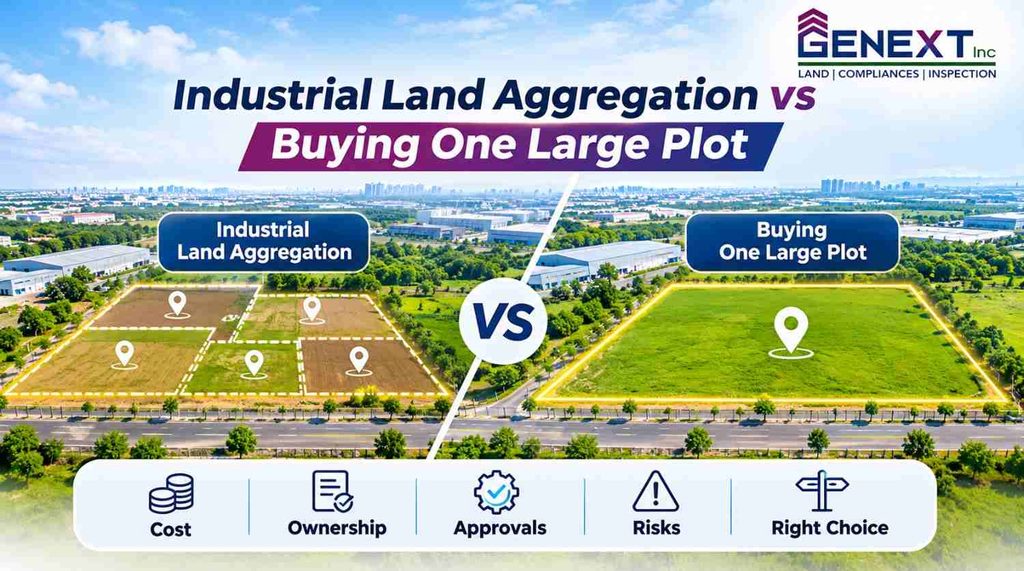
Industrial Land Aggregation: When it comes to selecting industrial land to build a factory, warehouse, logistics center or manufacturing plant, it is a crucial choice to make. Some companies buy one big continuous plot of land, but others take advantage of land aggregation to consolidate several smaller land plots into one. Both strategies can be used to foster industrial development, but they vary in ownership, documentation, approvals, time, cost, project risks, etc.
This awareness assists the businesses while taking any decision regarding investment in industrial properties, especially in creating industrial locations throughout the Haryana and the Delhi NCR region.
What is Land Aggregation?
The process of combining several small parcels of land into a single larger parcel for a desired land use is called land aggregation. These parcels may be owned by multiple parties and may need to be negotiated separately, have separate title and documentation before they are assembled for a common project.
For instance, a manufacturing firm might need 20 acres of land to build a manufacturing plant. If the company can’t find a 20-acre parcel in its desired location, the company may consider consolidating multiple contiguous parcels to meet the 20-acre requirement.
But the merged land doesn’t necessarily make it suitable for industrial purposes. The company has to check ownership, land use, access, relevant development controls and approvals it needs for its project.
Details about land aggregation may be particularly important when businesses require a specific site, a specific size of land, or flexibility in the choice of type of parcels that can be used to satisfy their operational needs.
What Does Buying One Large Plot Mean in Industrial Land Aggregation?
A single purchase of one large plot means the business buys one, undivided or split parcel of land that is suitable in size and location for the business. The buyer typically will not be negotiating with multiple landowners, but with one seller or the one legal landowner or entity.
In the case of a logistics company, that might be 20 acres bought from an existing 20-acre land parcel in an industrial neighborhood that’s suitable for their needs. The land may be more accessible and have good land ownership documentation, and the land use may be permitted, so that it is easier to acquire than to bring together several parcels.
But a big plot does not necessarily have an immunity to legal or development problems. The buyer shall pay the attention necessary to ensure the title, encumbrances, land usage, physical limits, access and applicable regulations are verified prior to close.
The primary benefit is the potential for a large block of land with minimal land ownership transfers.
Key Differences Between Industrial Land Aggregation and Buying One Large Plot
| Factor | Land Aggregation | Buying One Large Plot |
| Ownership | May involve multiple landowners | Usually involves one seller or ownership entity |
| Documentation | Requires coordination of multiple parcels and ownership records | Generally involves documentation for one parcel |
| Negotiation | Separate negotiations may be necessary | Usually involves one main negotiation |
| Timeline | Can take longer if owners or records create complications | May be quicker if ownership and permissions are clear |
| Land availability | Can help assemble the required area when large plots are unavailable | Depends on the availability of a sufficiently large plot |
| Cost structure | Includes coordination and transaction costs for multiple parcels | Typically involves fewer separate transaction processes |
| Project planning | Boundaries, access, and parcel alignment need careful coordination | A continuous parcel may simplify site planning |
| Risk factors | Additional risks can arise from inconsistent titles, disputed boundaries, or incomplete assembly | Risks may be easier to manage, but title and land-use issues can still exist |
These differences reflect general tendencies, rather than guarantees. Exactly how much, how long and how risky the undertaking is will depend on the property, ownership holding, location and associated laws.
Benefits of Industrial Land Aggregation
Land aggregation may be helpful if the area of land that needs to be acquired cannot be obtained in one continuous tract. It can enable companies to check out a number of smaller plots in a desired location, as opposed to just looking at massive properties that are currently on the market.
Location and connectivity are also important factors in industrial land selection. Businesses should evaluate how road networks, highways and nearby industrial infrastructure can influence transportation, logistics operations and long-term property value. Read more about the importance of industrial land connectivity and location before making an investment decision.
Some other pros and cons are:
- Greater location flexibility: Companies can access land in close proximity to key highways, industrial corridors, suppliers or distribution networks.
- Larger land areas available: Adjoining parcels that are appropriate may be combined to provide sufficient land for larger industrial projects.
- Flexible acquisition plan: businesses can assess various parcels and/or negotiate with each parcel owner based on a clear acquisition strategy with legal viability.
But there is a need to coordinate aggregation. The overall layout of the project or intended land area could be impacted if one of the essential parcels cannot be secured.
Advantages of Buying One Large Plot
Generally speaking, purchasing one large plot will make the acquisition process a lot simpler, especially if there are clear ownership and permits.
It has the following major benefits:
- Better transaction management: Administrative coordination can be simplified by fewer individual land purchases.
- Improved site planning: One parcel may be easier to plan buildings, roads within the site, parking, loading and utilities.
- Potentially quicker execution: A simple transaction could enable businesses to get project development underway earlier, but it could take some time for statutory approvals to be obtained.
More stable land size: Buyer does not have to arrange for the purchase of multiple parcels to reach the desired size.
Important Checks Before Choosing Industrial Land Aggregation
A few factors to consider before making a decision.
No matter how businesses acquire industrial land, they need to do adequate research before buying it.
1. Verify land ownership: Check title documents, land revenue, encumbrances, and land disputes. Ensure that you get legal counsel before taking any actions.
2. Ensure land use is appropriate: Determine if the land use is a legal use for the proposed industrial use. Development may need to be subject to applicable permissions or conversion in agricultural land or in other restricted-use land.
3. Conduct a connectivity and access assessment: Review the roads, transportation, utilities and legal access of the property.
4. Check relevant approvals: Work out planning permissions, building plan approvals, environmental clearance etc and other licences and consents for the project.
5. Assess the total project cost: look at the cost of the purchase, the stamp duty, the registration fees, legal fees, infrastructure development costs, land preparation costs, and any costs from delays.
For aggregated land, also ensure that all necessary parcels are available for purchase, access and use as proposed.
Which Industrial Land Aggregation Option Is Better for Your Business?
The right one will depend on the land space, financial considerations, location and timing of your project.
Land aggregation can be considered if a business requires a larger area through industrial land aggregation at a specific site where no single plot meets its requirements. A single large parcel might be preferable if an appropriate, registered piece of land is available and has the necessary connectivity and development options.
The choice should not be done based on land size, but based on the legal position of the property, permitted use, infrastructure and overall suitability for the business plan of the proponent for their industrial project in Haryana or Delhi-NCR.
Conclusion
There are two ways to obtain industrial land: land aggregation and purchase of a single piece of land. Two possible approaches include aggregation, making up land from several parcels, and buying a single large parcel, which may make coordination of ownership and site planning easier.
Both are not necessarily cheaper, faster or safer. The overall acquisition price, legal matters, feasibility, and risk of development should be considered and compared. With due diligence and expert advice, businesses can choose to acquire land that will enable them to achieve their long-term objectives.
For professional assistance with industrial land aggregation, land acquisition, and real estate compliance, connect with Genext Inc. Follow our latest updates, insights, and industry developments on LinkedIn.
