
How Infrastructure-Led Growth Influences Industrial Land Investment Decisions
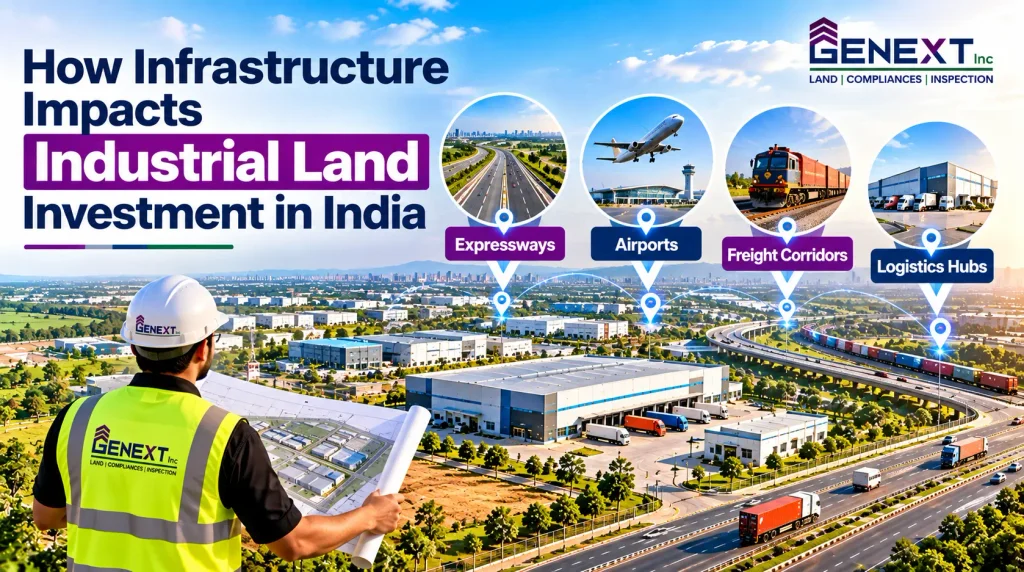
One of the best determinants of an industrial land investment decision in India is infrastructure. Access of the business to roads, expressways, rail lines, logistics centers, airports, industrial corridors, and utilities and planned industrial areas can have an impact on the ease of business operations.
But for investors the development of infrastructure should not be seen as just an opportunity for increased land values. The question that remains is whether the infrastructure enhances access, productivity of businesses, and the long term usefulness of the land.
India is increasingly focusing on integrated connectivity in its infrastructure planning. The government is developing infrastructure across various transportation modes under PM GatiShakti to enhance the mobility of people, goods and services. As on August 11, 2026, a total of 396 projects with an estimated cost of around ₹18.66 lakh crore have been assessed under the auspices of the Network Planning Group, of which 198 projects are being implemented.
1. How Road Connectivity Influences Industrial Land Investment
One of the primary things that businesses will take into consideration when they are choosing the industrial land is the road connectivity.
Having proximity to key roads, expressways and freight lines may simplify the movement of raw material, finished goods, equipment and personnel. Improved connectivity will also help to minimize travel time and increase access to nearby markets.
An example of this is that there are industrial areas in the NCR that are connected to the major highways and expressways. The proposed Greenfield connectivity of 31.42 kms between South Delhi, Faridabad, Gurugram and Jewar International Airport is aimed at providing high-speed connectivity and logistics efficiency and also gets interlinked with the Eastern Peripheral Expressway, Yamuna Expressway and Dedicated Freight Corridor.
The key conclusion for investors is that the fact that a road exists is not the most important factor. The quality, capacity and actual accessibility of that road to the land parcel is relevant.
2. Industrial Corridors and Industrial Land Investment Opportunities
Industrial Corridors can establish New Local Industrial Film production opportunities.
Industrial corridors connect key transportation networks with economic centres. They are based on industrial development and infrastructure (roads, railways, logistics facilities and utilities).
The National Industrial Corridor Development Programme uses key transport corridors like Dedicated Freight Corridors, expressways, national highways, ports and airports. One of its goals is to create industrial districts with secure infrastructure and multimodal connectivity.
This can create opportunities for industrial land within and near planned manufacturing and logistics centres.
For a broader understanding of industrial land availability, investors can also read about why large land parcels are becoming scarce in India’s industrial corridors.
Investors should however make the difference between announced and operational infrastructure. A project that is being proposed can take years to develop, shift in scope or not get implemented in time.
3. Logistics Infrastructure and Industrial Land Investment
In manufacturing, warehousing and distribution companies, efficiency in logistics can potentially have a direct impact on operating expenses.
Businesses may have more options to transport goods at a location near freight corridors, logistics parks, railways or from major highways.
One such example is the Integrated Multi-Modal Logistics Hub at Nangal Chaudhary in Mahendragarh, which is relevant to Haryana. The project will cover around 886 acres and will facilitate freight movement for industrial areas like Manesar, Bawal, Dharuhera, East Rajasthan, and parts of NCR and Haryana. The project also includes planned logistics facilities including EXIM zone, warehousing, container stacking and rail infrastructure.
This can impact investors’ assessment of surrounding industrial property as businesses can value the ease of access to logistics infrastructure.
4. Infrastructure Can Improve Long-Term Business Viability
When buying industrial land, it is important to consider how well it can sustain a business for years to come, in addition to the price.
Investors should review the following available and reliable:
- Road access and internal access.
- Electricity
- Water supply
- Drainage
- Sewerage
- Internet and telecommunications
- Public transport
- Warehousing and logistic facilities
- Residence and labour areas nearby
Government policy increasingly targets investment-friendly industrial regions with solid infrastructure. For example, the 2026 roll out of BHAVYA envisages 100 investment ready plug and play industrial parks, and project appraisal takes into account parameters like availability of land, connectivity, assured utilities and realistic development phasing.
5. Infrastructure Does Not Automatically Mean Higher Land Value
The common pitfall is using the assumption that all infrastructure announcements will drive up the value of industrial land.
Other factors that can impact land value may be zoning, land title, permitted use, connectivity, utilities, demand, development timelines, and surrounding industrial activity.
As such, investors should check if infrastructure is:
- Proposed or officially approved
- Under construction
- Partially operational
- Fully operational
This may be a big contrast in a decision to invest.
6. Haryana, NCR and Industrial Land Investment
Haryana is a good example of infrastructure induced industrial growth. The state is considering further Integrated Manufacturing Townships, with several sites being proposed that are tied to major transport corridors. The state government has also emphasized industrial development of industry along the KMP Expressway and its plans for new IMTs.
Another significant development is the Amritsar-Kolkata Industrial Corridor’s Integrated Manufacturing Cluster at Hisar. Covering an estimated area of 2,988 acres, the project has a stated investment potential of ₹32,417 crore, while the project cost is ₹4,680 crore.
The examples show the importance of investors better considering industrial land within a wider context of the infrastructure ecosystem, and not on a plot-by-plot basis.
7. What Should Investors Check Before Buying Industrial Land?
Businesses need to perform comprehensive due diligence before they make an investment decision, including:
- Current and new road connections
- Located far from the highways and expressways
- There is railway and freight infrastructure near the site.
- An airport and logistics connection was created.An airport and logistics connection was established.
- The zoning and permitted use of industrial land.
- Availability of utilities
- Surrounding industrial development
- Government infrastructure plans
- The records of land title and ownership.
- Any approvals and restrictions that may apply.
- The following shows proposed infrastructure development timeline.The timeline of proposed infrastructure development is as follows.
Conclusion
Infrastructure-led growth is revolutionising the way industrial land investment decisions are made in India. Improved roads, expressways, logistics hubs/ clusters, freight corridors can enhance accessibility and promote business development.
But infrastructure should be considered one part of a complete land evaluation process. Before investing in a land project, investors need to confirm the state of infrastructure in the area, understand its connectivity and utilities, and ensure legal and regulatory due diligence.
For professional guidance on industrial land, approvals and real estate compliance, connect with Genext Inc. on LinkedIn.
