Industrial Land Acquisition in India: Complete Guide for Businesses
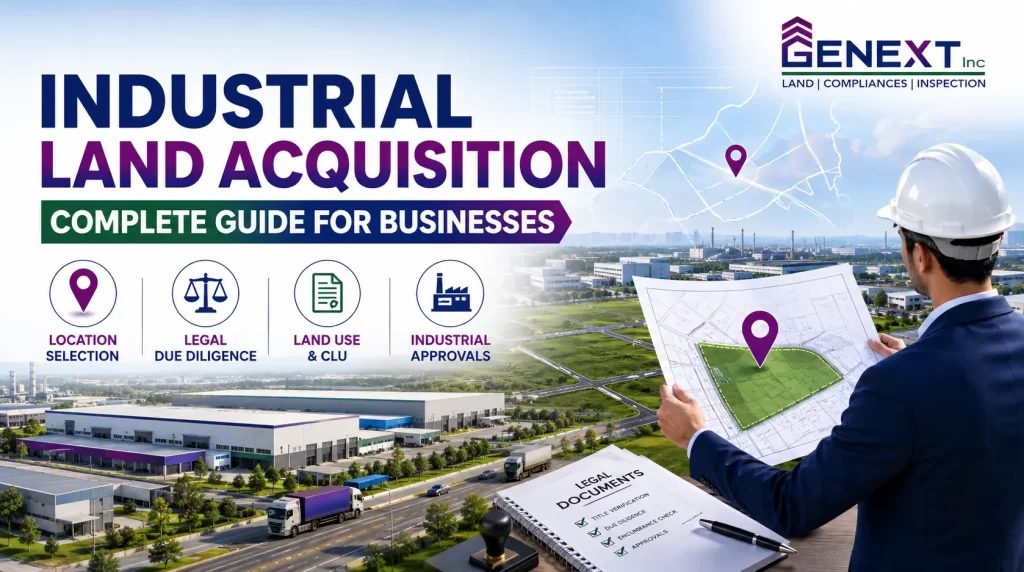
Industrial land acquisition in this comprehensive guide, learn about the world of industrial land acquisition in India, how to get the best deal, and the legal intricacies involved.
Before establishing a factory, manufacturing unit, warehouse, logistics park, industrial unit or large scale project in India, the most critical decision of a business is the acquisition of industrial land. A right land can facilitate the sustainability of growth, lower the operating costs, and enhance access to customer and suppliers. Conversely, the wrong land can present legal, regulatory, infrastructure and financial issues.
Thus, the price and location of the industrial land should not be the only factors the business considers when choosing industrial land. Key considerations for successful industrial land acquisition involve planning, legal due diligence, land-use verification, infrastructure assessment, regulatory checks, and financial evaluation.
The procedure may also differ from state to state in India. There are various factors that can impact on the suitability of a property, including local development plans, zoning, land records, environmental considerations, road access and industrial policies.
The process of industrial land acquisition in India, the considerations that businesses need to take into account, the pitfalls to avoid and how professional land procurement support can help make the process easier and efficient.
What is Industrial Land Acquisition?
Industrial land acquisition involves the identification of suitable land, assessment, legal verification, negotiation and acquisition of land for industrial or business development.
A company can obtain land in various ways, depending upon the nature of the project:
- Direct purchase
- Long-term lease
- Land aggregation
- Joint venture arrangements
- Industrial development authorities
- Private industrial parks
- Government-supported industrial areas
They have been taking over existing industrial properties.Existing industrial properties have been acquired.
It’s not about just buying up land. Rather, the goal is to obtain a parcel from a legal perspective and make it commercially viable, accessible and compatible with the company’s long term plans.
A manufacturing company may require land near the highways and suppliers, for instance. The main modes of access could be expressways, freight corridors, airports, or consumption centres. A warehouse operator, on the other hand, could need a big parcel that offers excellent truck motion and a steady power supply.
So, the optimum industrial land is based on the project’s requirements.
Why Industrial Land Acquisition? How important is it for businesses?
Land is an asset in the business. The cost and hassle of relocating an operation can be costly after an investment is made in a location.
Consequently, companies must conduct a thorough analysis of industrial land before investing money in it.
Planned industrial land acquisition can offer a number of benefits.
1. Better Strategic Location
The position of an industrial project can impact transportation costs, worker accessibility, supplier networks and customer reach.
A manufacturing plant might be required to be close to the raw materials supplier, for example. In the meantime, a logistics centre can require direct access to major roads.
So, choose the location based on the whole business plan and not just the cost of buying the location.
2. Reduce the Long-Term Operating Costs (LTOLC)
A lower priced house doesn’t necessarily make for the lowest cost.
If a site lacks road connectivity, little or no electricity, a lack of water or high transportation costs, the cost of the business may be much higher over time.
Therefore, businesses should consider all costs involved in the purchase of land before they make a decision.
3. Easier Regulatory Planning
In industrial projects, there may be several approvals and compliance requirements.
They can range from land-use permissions to building approvals, environmental permissions, pollution control approvals, fire safety requirements to others compliances and statutory requirements depending on the location and project type.
To minimize future delays, therefore, the regulatory status of the land should be verified prior to acquisition.
4. Long-Term Expansion Potential
The future expansion should also be taken into account by business enterprises.
There may be future needs for the company for more production lines, more storage, employee facilities, parking, or utilities.
Therefore, the availability of land nearby and the potential of the area for development should be assessed during the land acquisition process for industrial development.
A Step-by-Step Approach to the Industrial Land Acquisition Process in India.
The acquisition of industrial land should be done in a systematic manner. The process is different per state, authority and project, but typically follows the steps outlined below.
The first step involves identifying how much industrial land you need.
Step 1: Define Your Industrial Land Acquisition Requirements
Evaluate your needs before looking for land.
Consider:
- Required land area
- Project type
- Manufacturing and/or warehouse needs.
- Investment budget
- Preferred state and district
- Required road width
- Highway connectivity
- Distance from suppliers
- Distance from customers
- Electricity requirements
- Water availability
- Workforce availability
- Future expansion requirements
- Environmental considerations
For instance, hundreds of acres are needed for a large manufacturing project. A small industrial operation, on the other hand, can require just a handful of acres.
Thus, efficient acquisition of land for industrial purpose is begun by making a detailed land requirement brief.
Step 2: Determine the appropriate location
One of the most important considerations in industrial realty is location.
Businesses should consider the whole economy and the infrastructure that exists around the land.
Important factors include:
Road and Highway Connectivity
Inspect the distance to national highway, state highway, expressways and main roads.
Logistics costs and delivery time can be lowered by good connectivity.
Rail Connectivity
For companies that carry out heavy materials or big quantity of goods, rail access might be vital.
Airports and Ports
Having access to airports or ports can be advantageous for companies that are focused on export.
Industrial Corridors
Proximity to planned or existing industrial corridors could be a strategic benefit over the long term. But companies should check the plans and development timelines of the Government for themselves before making any investment decisions.
Availability of Labour
If skilled and semi-skilled employees are not available in a location, it can be commercially appealing, yet operationally challenging.
Social Infrastructure
Facilities such as housing, healthcare, education, banking and other facilities can impact employee recruitment and retention.
As such, there is a need for businesses to evaluate the industrial ecosystem and the community.
Step 3: Review Land Use and Zoning
Assessing the legality of the land (whether the land would be suitable for the proposed project) is one of the most important aspects of acquiring industrial land.
The purchaser’s responsibility is to carry out the following checks:
- Current land classification
- Master plan zoning
- Industrial zoning
- Permitted activities
- Development controls
- Flour Area or Development Parameters
- Road access requirements
- Applicable land-use permissions
- Assess and document the impact of a change of land use, if applicable (CLU)
One of the common errors is taking the position that buying a parcel equates to the buyer having the right to build and run any kind of industrial facility.
It does not.
The right to buy land and the right to build and use it for a specific purpose is two distinct issues.
Hence, the land-use verification should be finished prior to finalizing the transaction.
There is some variation in requirements from state to state and from authority to authority. For instance, a few changes have been introduced in Haryana recently to simplify some of the processes related to businesses and land use, such as CLU and industrial approvals. Businesses should always check the up-to-date regulations that apply to their specific location and project, however.
Step 4: Do Legal Due Diligence
The legal due diligence is one of the most important parts of industrial land acquisition.
The purpose is to ensure that the seller is the owner of a clear and marketable title, and that the land is not subject to unknown legal issues.
The due diligence process may include checking:
- Ownership records
- Previous sale deeds
- Encumbrance records
- Revenue records
- Mutation records
- Property tax records
- Court cases
- Mortgages or charges
- Acquisition notifications
- Easement rights
- Access rights
- Boundary details
- Land measurement
- Existing agreements
- Restrictions on transfer
This is a state and property specific requirement.
But the bottom line is that you should not take everything on the seller’s word or on his/her paperwork.
It is imperative to have independent verification.
When the title is unknown or there are missing links in the chain of title, the transaction could result in substantial problems down the road.
Step 5: Verify Physical Infrastructure
The legal ownership is just a portion of the process of industrial land acquisition.
Physical suitability of the land is also of importance.
Businesses should inspect:
- Road access
- Road width
- Internal approach roads
- Electricity availability
- Water supply
- Drainage
- Sewage facilities
- Internet connectivity
- Availability of gas if needed for cooking or heating,
- Stormwater management
- Flood risk
- Soil conditions
- Land level
- Nearby settlements
- Existing industrial activity
Before finalising the land a site visit needs to be carried out.
Furthermore, it’s crucial to find out how the condition of the land actually compares with the official documents and plans that have been approved.
Technical and environmental assessments may also be needed for larger projects.
Step 6: Evaluate Environmental and Regulatory Requirements
Compliance with the environment is a key aspect of industrial projects.
Requirements vary on the basis of:
- Type of industry
- Production capacity
- Project size
- Location
- Pollution potential
- Water consumption
- Waste generation
- The area is sensitive to the environment.
Depending on the project, it may be necessary to obtain approvals/permissions from relevant authorities.
These can include environmental clearances, pollution control permissions, consent requirements, waste management approvals and other project specific compliances.
Hence, environmental feasibility should be conducted at an early stage.
Buying land after the project starts can result in added delays and risks.
Organizations can leverage the expertise of a professional consultant to determine which entity is responsible for the approval process and to identify potential issues in complying with the appropriate approval process in the initial stages of industrial land acquisition.
Step 7: Assess the Total Project Cost
The purchase price is not the ‘full cost of industrial land acquisition’.
The total investment that is needed to operated the site should be calculated by the business.
The total price could be:
- Land purchase price
- Stamp duty
- Registration charges
- Brokerage
- Legal fees
- Due diligence costs
- Where applicable, include costs associated with land conversion or the CLU.
- Development charges
- Infrastructure development
- Road improvement
- Utility connection costs
- Construction costs
- Environmental compliance costs
- Financing costs
Thus, although a land parcel might seem cheap at first glance, when all of the extra costs are taken into account, the price might be high.
Comprehensive financial feasibility analysis can be useful in making more accurate comparisons of locations.
Step 8: Negotiate Commercial Terms
When a suitable parcel has been found and preliminary due diligence has been conducted, the next steps are negotiation.
Businesses should evaluate:
- Purchase price
- Payment schedule
- Advance amount
- Possession timeline
- Registration conditions
- Seller obligations
- Existing liabilities
- Taxes and charges
- Conditions precedent
- Exit clauses
- Documentation requirements
The contract should explicitly outline the duties of the two parties involved.
Businesses should utilize qualified legal professionals to structure and review transaction documents for larger transactions.
Step 9: Complete Documentation and Registration
Once commercial terms are agreed the deal is put in the documents and registered.
This could include:
- Agreement to sell
- Due diligence completion
- Payment of unpaid obligations and debts.
- The actual sale or lease of these documents.
- Fully payment of appropriate duties
- Registration
- Changes to a record, mutations, or changes to the gene.
- Physical possession
The order of the steps may vary by state and transaction type.
Businesses should therefore adhere to the appropriate local law and registration procedures.
Step 10: Start Project Approvals & Development
It’s not the end of the process when you acquire land.
Following acquisition, the business might require project-specific approvals.
This may involve:
- Building plan approval
- Factory-related approvals
- Fire safety permissions
- Pollution control approvals
- Environmental permissions
- Electricity connection
- Water connection
- Labour-related registrations
- Approval for occupancy or completion.
Approval will be based on the nature, size, location and operations of the project.
Need Warehouse Space After Acquiring Industrial Land?
Planning your industrial project doesn’t end with land acquisition. Choosing the right warehouse is equally important for efficient logistics and business growth. Read our complete guide on Warehouse for Rent in India for expert insights and practical tips.
Before buying industrial land, there are so many key factors that you need to consider
There are several things businesses should consider before closing a property.
1. Location
Does the site have good access to suppliers, customers, highways, ports, airports and labour markets?
2. Land Title
Do owners understand and know how to transfer ownership?
3. Land Use
Will the proposed industrial activity be allowed to be undertaken on the land?
4. Infrastructure
Do utilities, such as electricity, water, roads, drainage, etc. exist?
5. Environmental Risk
Do there exist any environmental limitations or project specific requirements for approval?
6. Future Development
Is it possible to grow the business from the same site?
7. Total Cost
What is the complete cost of acquisition and development?
8. Market Potential
Will site be viable commercially in the next 10-20 years?
9. Connectivity
Are there efficient access routes for trucks, employees, suppliers and customers to the site?
10. Regulatory Risk
Have there been recent changes in the zoning, infrastructure or development plans that may impact the project?
A good industrial land acquisition policy takes all these elements into account.
The typical pitfalls of businesses that they should avoid
Businesses must take time to deal with the land acquisition process to avoid risky industrial land acquisition.
Here are some of the mistakes that are usually made.
Land Only If It’s Cheap:
Mistake 1: The first mistake is to only select land because it’s cheap.
The lowest price isn’t necessarily the best value.
Low connectivity or infrastructure can lead to high operating costs.
Mistake 2: Not doing legal due diligence.
The low cost property that has not been identified can cause problems.
Mistake 3: Too often, they overlook land use.Too often they ignore land use.
Purchasing land without confirming the allowed usage of the property may stall or stop development.
Mistake 4: Not Checking Access Roads
If heavy vehicles can’t move in and out of the large parcel, it isn’t useful.
Mistake 5: By mistake, you forget to consider future expansion.
Companies need to consider more than what they need for today.
Mistake 6: Thinking that Approvals are automatic
Each project will have specific regulations.
Mistake 7: Consider the following mistakes that people make when buying a home.
The costs of the actual investment would cover development, infrastructure, approvals and operating expenses.
Mistake 8: Making the Error: Only Using Online Listings.
The information on a property listing online may not be a true and complete representation of the title, zoning, infrastructure, or regulatory status.
So, it is critical to have professional verification.
Why Businesses Work With Industrial Land Acquisition Consultants
Industrial land is bought by businesses with the help of Industrial Land Acquisition Consultants.
The process of land acquisition for industries is a multi-stage one.
It involves all real estate, legal, financial, regulatory and technical factors.
This can lead to the use of professional business consultants who can manage the various stages of the process.
A professional land acquisition consultant can help with:
- Requirement assessment
- Location strategy
- Land identification
- Market research
- Land aggregation
- Preliminary property screening
- Due diligence coordination
- Land-use assessment
- CLU-related guidance
- Coordinating activities for environmental and pollution compliance.
- Negotiation support
- Transaction coordination
This can be a time saving management tool.
Most significantly, it can be helpful for businesses to uncover risks before large investments are made.
Genext Inc. is an aggregation and land procurement company that supports projects for large projects, such as industrial/warehousing/ institutional. It is said to provide services such as land identification, due diligence, land-use and compliance support, and transaction facilitation in the regions of Haryana, Punjab, Rajasthan, Uttar Pradesh, Gujarat and Madhya Pradesh.
If you are looking to expand your business to an industrial zone, the professional’s assistance can make all the difference between just finding land and finding land that works.
Industrial Land Acquisition in India: A Practical Checklist
When negotiating a final contract, the following questions should be posed by businesses:
Location
Does the site have a strategic suitability?
Are the roads suitable for use?
Will heavy vehicles be able to access the site?
Is there a location that is convenient for suppliers and customers?
Legal
Is the title clear?
Is ownership information proofed?
Any restrictions?
Are there any disputes that are outstanding?
Land Use
Does the land have a potential for the proposed industrial development?
Do the zoning match?
Does CLU or a similar land use permit need to be obtained?
Infrastructure
Is adequate power available?
Is water available?
Is drainage sufficient?
Do road and utility improvements need to be made?
Environmental
Do environmental permissions need to be obtained?
What are the regulations for pollution control?
Are there any environmental constraints?
Financial
How much does it cost to put into the system?
What are the other costs of development?
Is this a viable site for the project?
Future Growth
Is expansion possible?
Will the area be developed in the future?
Are there any planned projects in the future for infrastructure?
This checklist can help businesses lower avoidable risks prior to a big real estate investment.
Some important questions and answers regarding Industrial Land Acquisition.
What do you mean by industrial land acquisition?
The process of identifying, evaluating, legally validating, negotiating and acquiring land for manufacturing, warehousing, logistics, industrial or related business projects is known as industrial land acquisition.
What are the things that I need to analyse before purchasing industrial land in India?
Prior to industrial land acquisition, businesses should verify land title ownership, zoning, land use, access roads, infrastructure, utilities, environmental, development potential and overall project costs.
Is it possible to develop an industrial project on agricultural land?
Not necessarily. Use is permitted depending on local laws and zoning, master plans and applicable permissions. In a few cases, conversion of land use may be necessary, or CLU may be necessary. However, businesses should check the precise specifications that are relevant to the specific project and property.
Are industrial land acquisition in all States in India equal?
Individual State and local governments may have different land and development rules. So, businesses must do location-specific due diligence before going ahead.
So how long does it take for acquiring industrial land?
There are no set times. The time would vary based on land availability, the title search, negotiations, approvals, documentation and complexity of the project.
Would it be better for businesses to purchase or lease industrial property?
It is determined by the business model, capital, the length of time the business will take place, expansion plans, and location. With the purchase, the owner may obtain asset ownership, while leasing may offer more flexibility and less upfront capital in acquiring the asset.
What does due diligence mean for an industrial land acquisition?
If a business is thinking about investing a lot of funds, it is vital to conduct due diligence that can uncover any potential problems with the ownership, title, encumbrances, land use, access, approvals, and development restrictions.
Will a consultant be able to assist with acquiring industrial land?
Yes. A professional consultant can help businesses identify land, conduct market research, coordinate due diligence, aggregate land, provide regulatory guidance, assist with negotiation and help to facilitate transactions.
Stay updated with the latest insights on industrial real estate, land acquisition, and business expansion in India.
Follow Genext Inc. on Social Media for expert tips, industry updates, and investment opportunities.
