Green and Sustainable Manufacturing Plants in Northern India
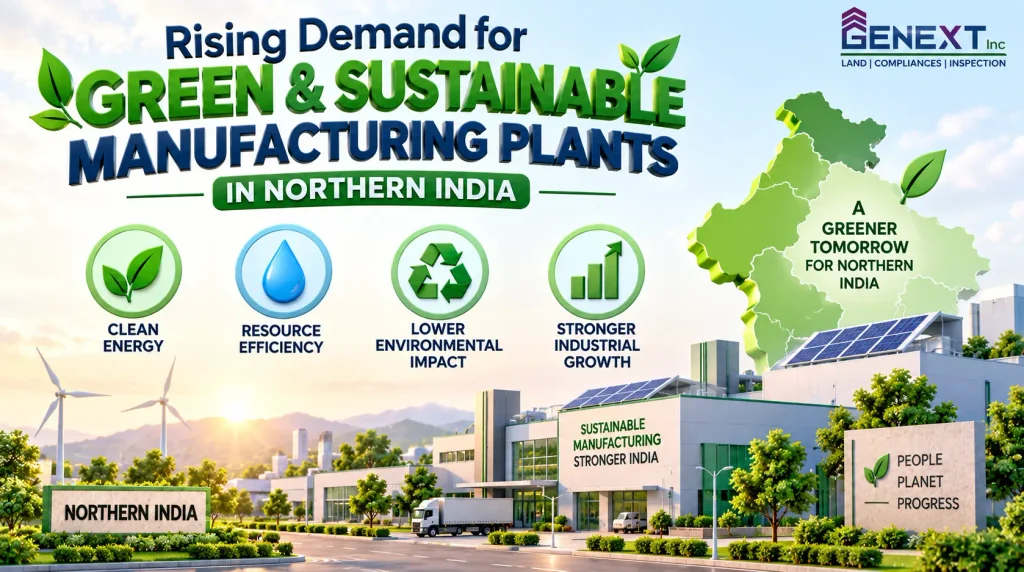
Today, the manufacturing in Northern India has been going through a new era. The main criteria for evaluating factories for years were production capacity, location, labour availability, operating costs, etc. Energy efficiency, water conservation, waste management, renewable power and environmental performance are increasingly all important issues today.
As a result, This change is driving increased interest in green and sustainable manufacturing plants in northern India. Companies also seek to manage long-term total cost of ownership (TCO) and meet growing market demand for sustainable operations.
Moreover, Northern India has several major industrial and manufacturing hubs. These include Haryana, Uttar Pradesh, Punjab, Rajasthan, Himachal Pradesh and the NCR. The areas are home to automotive, engineering, textiles, pharmaceuticals, food processing, electronics and other manufacturing industries. Sustainability is a vital component of plant planning, construction and operations, as industrial development increases.
Why Is Demand for Sustainable Manufacturing Increasing?
First, one of the primary ones is energy efficiency.
In addition, Factories can reduce unnecessary energy consumption through efficient equipment and LED lighting. High-efficiency HVAC, automation and energy monitoring can also help.
India’s National Mission for Enhanced Energy Efficiency (NM EEE) supports industrial energy efficiency. This includes the Perform, Achieve and Trade (PAT) scheme. Furthermore, the government also introduced ADEETIE in 2025 with a budget of ₹1,000 crore for enabling eligible MSMEs to use energy efficient technologies.
Therefore, this is especially true of industrial clusters where companies are seeking feasible solutions to modernise their current facilities.
Renewable Energy Is Becoming Part of Factory Planning
Similarly, in the design of industrial plants, solar energy is more often being thought about than just added on.
However,Factories can assess energy sourcing options based on electricity demand, available space and local regulations. Options include rooftop solar and captive renewable power. According to NITI Aayog, the industrial renewable installations have been growing in India in recent years and solar and wind energy are significant shares of the non-utility renewable power installed capacity.
The movement is also gaining momentum in other areas than electricity. In 2026, the MNRD had launched a scheme of support for Concentrating Solar Thermal (CST) based industrial process heating, assistance of up to 50% with a cap of ₹2 crore for the projects eligible for it.
This means an increased shift away from traditional fossil-fuel energy in manufacturing processes for manufacturers.
Water Management Is Another Critical Priority
Industries with processes that use a lot of water need to pay particular attention to water efficiency.
Rainwater use, wastewater treatment, wastewater recycling, process water recovery and zero liquid discharge systems can be integrated into a sustainable manufacturing facility as needed.
These measures can help to decrease the reliance on freshwater and increase operational resilience. Water recycling is already being shown by water recycling leaders in industry. For instance, Hindalco says it used 18.91 million cubic metres of water in its aluminium and copper plants during FY2023-24.
It is easier to think about water needs at the design phase of a new factory than to try to make major changes after the building is finished.
Sustainable Buildings Are More Than Solar Panels
This is a more comprehensive approach needed for a truly sustainable manufacturing site.
The design of the building can be tailored to accommodate:
- Use of energy efficient lighting and electrical systems
- The effective ventilation and cooling.
- Better building-envelope performance
- Where possible, natural daylight has been used.
- Rainwater harvesting
- Water-efficient fixtures
- Sustainable construction materials
- Waste is segregated and recycling is carried out.
- The planting of green spaces and landscape planning.Planning of green spaces and landscape planning.
- The efficient handling of materials and employees.The efficient transfer of materials and people.
The Green Factory Buildings rating system by Indian Green Building Council (IGBC) has been developed to assess industrial buildings including energy, water, environmental performance and other sustainability aspects.
The requirement for energy conservation is also applicable to the applicable buildings in Haryana. The Energy Conservation Building Code has been required in the state for certain types of buildings, says HAREDA.
Northern India Has a Strong Opportunity
The continued interest in manufacturing and industrial infrastructure is witnessed in the industrial areas around Delhi-NCR, Haryana, Uttar Pradesh, Punjab and Rajasthan. This provides a chance to consider sustainability at the project’s outset. Businesses also evaluating warehousing requirements can explore our Warehouse for Rent in India: Complete Business Guide 2026 for a detailed understanding of warehouse options and considerations.
For example, energy audits can be carried out prior to equipment selection, renewable energy opportunities can be identified during the design phase, water systems can be planned based on the process needs and waste-management systems can be planned before operations begin in a manufacturing project.
This can be especially beneficial to companies installing new facilities, as well as businesses upgrading factories.
The idea of green and sustainable manufacturing plants in the Northern region of India thus goes beyond just building an environment-friendly factory. It’s about creating an industrial facility that can operate more efficiently for its lifetime, and use resources more intelligently.
The Role of Inspection and Performance Verification
It is important that systems are designed, installed and maintained correctly, otherwise sustainability goals will not provide value.
Prior to opening a manufacturing facility, it is important for businesses to review electrical systems, HVAC installations, insulation, lighting, water systems, drainage, fire-safety systems, construction quality, and other critical elements.
An energy audit will also help identify ways to save energy. HAREDA offers schemes and procedures on the energy audit for industries and commercial establishments.
Periodic technical inspections are useful in identifying inefficiencies, defects, water leakage, poor installation and maintenance practices at existing facilities that can contribute to higher operating costs.
What Does the Future Look Like?
The message is loud and clear: Industrial growth and sustainability are going together.
A growing market for lower-carbon products, circular-economy practices and green technologies provide new incentives for Indian manufacturers to become more resource efficient. The potential scale of opportunity to create jobs and attract investment through India’s green economy was exemplified in a 2026 CEEW policy brief, which projects a creation of over 48 million jobs in India by 2047, and an additional USD 4.1 trillion in investment for India’s green economy.
For Northern Indian manufacturers, it’s not just an environmental opportunity. Optimizing energy use, managing water and water-based systems, and reducing waste and improving building performance can further ensure operational resilience and competitiveness.
Green and sustainable manufacturing plants will play a crucial role in the manufacturing landscape in Northern India in the future as the infrastructure evolves.
When designing a new factory or installing new equipment to upgrade an existing one, it’s important to include sustainability in the design process rather than tacking it on to an existing factory when it’s already constructed.
Conclusion
Manufacturing facilities of the future are headed towards creating efficiently with a reduced input of energy, water and raw materials. The robust industrial sector in the north of India provides ample scope for industrial firms to embrace them at large scale.
Fostering sustainable factories today can support companies to meet evolving environmental demands, to enhance resource productivity and to design more sustainable industrial processes for tomorrow.
A sustainable manufacturing plant is not only a green factory, but, also a smarter long-term business investment.
For more insights on industrial real estate, regulatory compliance and sustainable development, follow Genext Inc. on LinkedIn.
