
Delhi Master Plan 2047: DDA’s Blueprint for High-Rise Towers, TOD, and 40 Lakh Homes
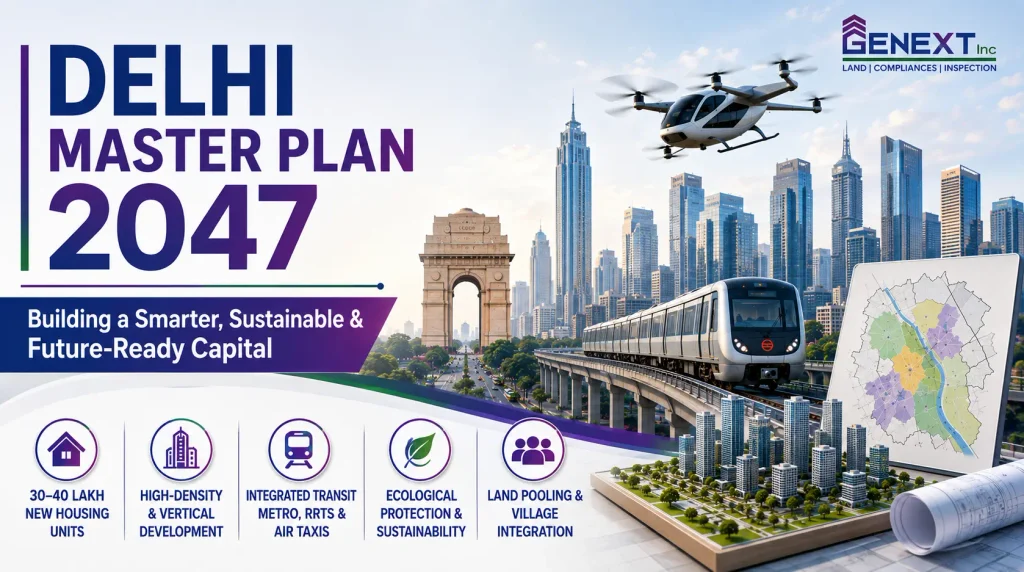
Delhi Master Plan 2047 is heading towards an urban revolution. As a result, the capital is expected to experience significant changes in its urban development pattern. The Delhi Development Authority (DDA) has approved the Master Plan for Delhi 2047 (MPD-2047), which is a key initiative of the government’s vision of Viksit Bharat. Furthermore, with a projected population of almost 3.2 crore by 2047, this spatial policy framework will shift the capital from an obsolete horizontal development pattern to a contemporary, high-density and vertical urban ecosystem.
Therefore, MPD-2047 is essential for real estate investors, homeowners, urban policy analysts and citizens of the NCR to understand the future of the capital.
MPD-2047 is essential for real estate investors, homeowners, urban policy analysts and citizens of the NCR to understand the future of the capital.
Official Government Data & Verification Sources
The government is rolling out a massive housing push in order to provide 30-40 Lakh new dwelling units.
MPD-2047 aims to create 30-40 lakh new housing units. In addition, the plan focuses on affordable housing. For example, compact units with carpet areas of 25 to 60 square meters will be promoted.
Affordable Housing Focus: Additionally, compact and affordable units with carpet areas of 25 to 60 square meters are being promoted with incentives.
Redevelopment Rights for Old Estates: Moreover, if flats built by the DDA are more than 50 years old, they may receive additional redevelopment rights similar to those available for vacant plots.
Built-to-rent complexes are located in key education and business corridors, with regulatory policies encouraging them.
2. This is the second installment in the High-Density & Vertical Development series, which marks the 100-Storey Era.
Unlike the normally low-rise homes, MPD-2047 takes a bold step towards vertical development. In particular, the nodes of TODs are key areas where new development should occur. Furthermore, higher Floor Area Ratio (FAR) will be focused around major mass transit hubs within 500 metres.
The nodes of TODs are the key areas where new development should occur.
Furthermore, the plan includes landmark buildings taller than 100 storeys in designated high-density areas. At the same time, higher Floor Area Ratio (FAR) will be focused around major mass transit hubs within 500 metres.
Freehold Conversions along Corridors
Within the designated TOD corridors, plots in leasehold can be converted to freehold status on payment of dues. As a result, this can reduce potential complications during private redevelopment and land assembly.
Protected Zones (Exclusions)
However, vertical development will not be permitted in sensitive historical and ecological zones.
- Lutyens’ Bungalow Zone (LBZ)
- Civil Lines Bungalow Zone
- This is a buffer regulated area of Connaught Place & ASI Monument.
- Delhi Ridge and Yamuna Active Floodplains
3. Integrated Transit Infrastructure: Metro, RRTS and Air Taxis
MPD-2047 directly connects urban land use with multi-modal transportation. Additionally, the plan aims to strengthen connectivity through Metro, RRTS and future mobility infrastructure.
| Mobility Sector | Current Status | Master Plan 2047 Target | Key Highlights |
| Delhi Metro Network | ~416 km | 695 km | Rithala-Kundli expansion, deep urban penetration. |
| RRTS Corridors | Regional lines active | 6 New Corridors | Rapid regional integration across NCR. |
| Multi-Modal Hubs | Fragmented transfers | 3 Unified Hubs | Mega interchange stations at Anand Vihar, Sarai Kale Khan, & Kashmere Gate. |
| Future Mobility | Conventional transit | Air Taxis & Pods | Designated sky-port infrastructure connecting IGI Airport & Noida (Jewar) Airport. |
Together, these mobility initiatives are expected to strengthen connectivity across Delhi and the wider NCR
4. Land Pooling Policy & Village Integration
Delhi’s urban expansion continues to focus on unlocking private land and reducing administrative delays. Meanwhile, land pooling is being streamlined to make participation easier for private landowners. As a result, larger land parcels can potentially become available for planned development.
Land Pooling Streamlining: Furthermore, individual private landowners can pool land through streamlined requirements, including reduced minimum sector sizes and relaxed consortium requirements.
Green Development Areas (GDA): Approximately 69 to 70 fringe villages in the GDA belt will be developed within the framework of Green Development Areas, as eco-friendly residential and commercial hubs with controlled FAR valuations.
Urban Village Upgrades: 105 villages directly involved in town-planning schemes for infrastructure modernisations.
5. Ecological Protection & 24×7 Night Economy
At the same time, MPD-2047 aims to balance economic productivity with environmental conservation through targeted interventions across different zones.
For example, the Wazirabad to Okhla section of the Yamuna has 1,700 hectares of floodplain, where 13 major ecological projects are being implemented to rejuvenate the stretch.
MPD-2047: Night-Time Economy (NTE) – To foster the growth of the service sector, MPD-2047 sets up commercial nodes that operate at night. There will be designated cultural, retail and entertainment circuits all year round, with dedicated night transit and pedestrian friendly areas.
What MPD-2047 Means for Property Owners & Buyers
More Housing Supply: Land pooling and high density TOD corridors will unlock significant housing supply, reducing acute core city density.
Clarity on Land Use Rules: Property buyers to check land is in the zone of legally notified rules in place and not unnotified layout draft rules.
For industrial and large-scale developments, compliance planning should begin at the early project stage to avoid regulatory delays, approval issues and unexpected risks. Learn more about Early-Stage Compliance Planning for Industrial Projects.
Value Apprehension along Transit Line Belts: High-density vertical rights and freehold options will be useful to keep properties close to Metro and RRTS nodes for high long-term value appreciation.
Delhi’s Master Plan 2047 provides a detailed plan to develop a resilient, high-density and sustainable capital for future generations. By staying up to date with official DDA notifications, property owners and developers can maximize the opportunities afforded in this transformative time.
Finally, properties located close to Metro and RRTS nodes may benefit from long-term demand driven by improved connectivity and higher development potential.
Stay connected with Genext Inc. official LinkedIn page for the latest updates on land, real estate compliance, inspections and urban development.
