How Private Industrial Parks Are Changing Land Valuation Models
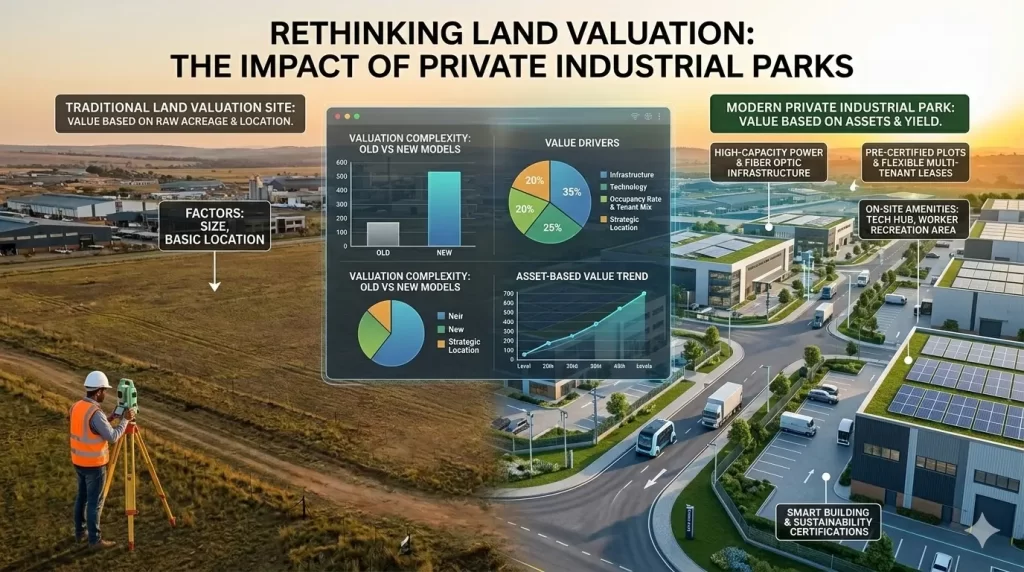
Industrial land valuation in India has traditionally been driven by a few core factors: location, connectivity to highways or ports, zoning permissions, and availability of utilities. However, the rapid expansion of private industrial parks and logistics clusters is beginning to reshape how industrial land is priced and valued.
Across several regions of India, large private developers are creating integrated industrial ecosystems that include infrastructure, regulatory support, and ready-to-operate facilities. As these parks become more common, they are influencing the way investors, developers, and occupiers evaluate the value of industrial land.
Understanding how private industrial parks affect land valuation models is becoming increasingly important for stakeholders involved in industrial real estate development.
The Rise of Private Industrial Parks
Private industrial parks are large, planned developments created by private developers rather than government industrial development authorities. These parks are typically designed to accommodate multiple industries and provide shared infrastructure such as:
- Internal road networks
- Reliable power supply
- Water and sewage systems
- Logistics access points
- Fire safety infrastructure
- Warehousing and manufacturing zones
Unlike traditional industrial estates, private parks often focus on integrated planning and long-term operational efficiency, making them attractive to both domestic and international companies.
Shift from Location-Based Valuation to Infrastructure-Based Valuation
Historically, industrial land values were largely determined by proximity to major highways, cities, or ports. While location still matters, private industrial parks are introducing a new valuation dimension: infrastructure readiness.
Land within a well-planned industrial park often commands a higher price because it provides:
- Pre-developed internal infrastructure
- Clear zoning for industrial activities
- Reduced project setup timelines
- Simplified regulatory processes
This means the value of land is increasingly linked not only to location but also to the quality of industrial infrastructure already in place.
Similar trends can be seen with expressway-led growth, where improved connectivity is creating new industrial investment zones and influencing land demand patterns. Read more about how expressway-led development is redefining industrial land strategy.
Reduced Development Risk Increases Land Value
One major advantage of private industrial parks is the reduction of development uncertainty.
When land is part of an organized industrial park, developers and occupiers benefit from:
- Pre-approved layouts
- Planned access roads and transport routes
- Utility infrastructure already in place
- Dedicated industrial zoning
These factors reduce project risks and delays, which makes the land more attractive to investors and occupiers.
As a result, land parcels within such parks often experience higher and more stable valuation compared to standalone land parcels.
Impact on Land Aggregation Strategies
Private industrial parks also influence how developers approach land acquisition.
Instead of purchasing scattered parcels individually, developers often focus on aggregating large contiguous land parcels to create planned industrial ecosystems.
This approach leads to:
- More efficient land utilization
- Higher development density
- Greater long-term value creation
Large aggregated parcels are increasingly viewed as more valuable because they enable the development of structured industrial parks rather than isolated industrial units.
Influence on Institutional Investment
Institutional investors and global companies typically prefer organized industrial environments that provide operational reliability and long-term scalability.
Private industrial parks offer several advantages that influence land valuation from an investment perspective:
- Better compliance frameworks
- Planned infrastructure expansion
- Improved logistics connectivity
- Higher potential for long-term leasing demand
Because of these factors, institutional investors often place a valuation premium on land located within professionally developed industrial parks.
Changing Buyer Preferences
Industrial occupiers today are also more selective about where they establish operations. Many companies now prefer locations that offer:
- Plug-and-play infrastructure
- Predictable utility supply
- Faster construction approvals
- Efficient logistics connectivity
Private industrial parks are designed to meet these expectations, which increases demand for land within such developments and further strengthens their valuation.
Long-Term Impact on Industrial Land Markets
As more private industrial parks are developed across India, the industrial land market is gradually shifting toward cluster-based development models.
In the long run, this trend may lead to:
- Higher land value concentration around organized industrial clusters
- Reduced demand for fragmented industrial land parcels
- Increased preference for master-planned industrial environments
Developers who understand these trends can make more informed decisions when planning land acquisition and development strategies.
Conclusion
Private industrial parks are playing an increasingly important role in reshaping India’s industrial real estate landscape. By combining infrastructure readiness, regulatory clarity, and strategic location planning, these developments are changing how industrial land is evaluated and priced.
For developers, investors, and industrial occupiers, understanding these evolving valuation models is essential for making informed decisions in a rapidly transforming industrial property market.
Get the latest updates, industry insights, and compliance-related information by following Genext Inc. on Facebook.
