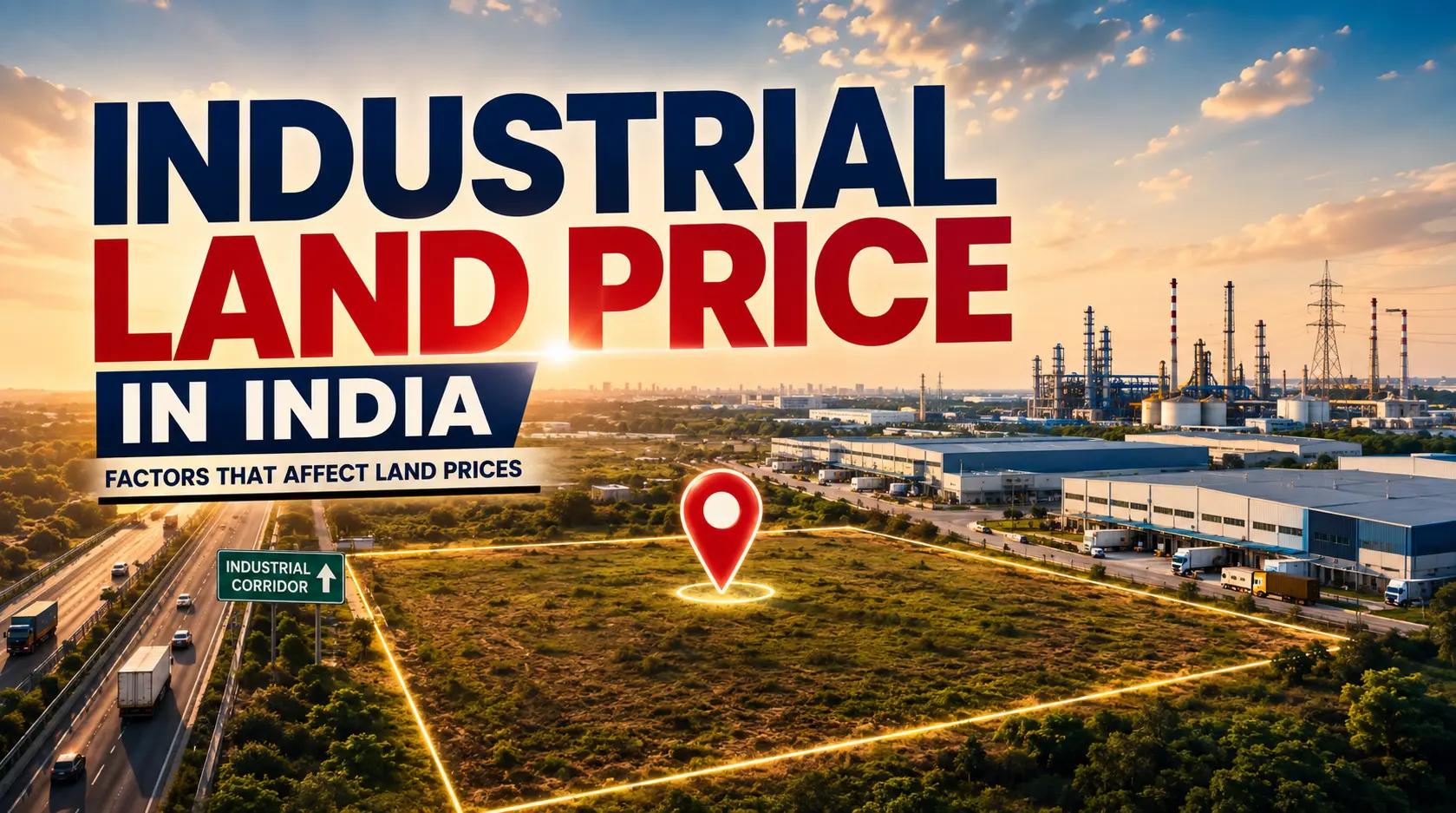
Industrial Land Price in India: Factors that Affect Land Prices
Industrial land price in India is directly influenced by the various factors that affect land prices.The industrial real estate market in India is growing at a robust pace with the growth in manufacturing activities, growing demand for warehousing, infrastructure development and the government’s initiatives to promote the industrial development.
When it comes to companies that are about to begin manufacturing factories, warehouses, logistics parks, or large industrial projects, choosing the right land to construct the project is one of the most crucial decisions. The value of land depends on more than just its size and location. The overall value is influenced by a number of factors including connectivity, infrastructure, approvals, market demand and future development potential.
By understanding these elements, businesses can make informed decisions on investments and select optimal locations to foster sustainable growth.
Knowing the Industrial Land Pricing in India.Knowing the Industrial Land Pricing in India.
Industrial land is not a residential or commercial land as it is primarily used for industrial or manufacturing activities, for storage and for logistics.
The prices of industrial land are quite different based on region, development and facilities. Land close to major highways, industrial corridors, ports, and big cities is typically in greater demand because of its improved accessibility and operational benefits.
But companies shouldn’t base their land purchase solely on the acquisition price. Better infrastructure and connectivity can generate higher returns with a somewhat higher cost of location than a lower cost location in a less connected area.
The key determinants of industrial land prices are discussed below. The factors influencing the prices of industrial land are discussed below.
1. Location and Connectivity
One of the most significant factors that impact on the value of industrial property is location. Companies like to be located where transportation is good, as is access to suppliers, customers, and skilled employees.
Industrial property around big roads, expressways, railways and logistics centers tends to be more sought after. Improved connectivity saves companies on transportation costs and makes the supply chain more efficient.
For instance, manufacturing and warehousing firms tend to favour locations close to national roads or specially laid out freight corridors.
Strategic location is beneficial for the long term, such as quicker goods transferring and improved business development chances.
2. Infrastructure Availability
Infrastructure is a key factor in land valuation. For industrial projects, reliable facilities are crucial to efficient operation.
Factors important in infrastructure are:
- Electricity availability
- Water supply
- Road connectivity
- Drainage systems
- Internet facilities
- Transportation access
An existing infrastructure makes it easier to setup the project, and investors are more inclined to invest in such sites.
However, in undeveloped areas, land costs are lower but basic facilities may be required to be done at a different cost. The additional costs can add up to a considerable amount of the overall project cost.
3. Industrial Corridors and Business Hubs are nearby.
New growth opportunities are emerging by the development of industrial corridors throughout India. The planned development areas are attracting manufacturers, logistics companies and investors.
Near industrial corridors typically have growing demands because they provide:
- Better infrastructure planning
- Improved transportation facilities
- Business networks are available for access.Business networks are accessible.
- Future development opportunities
Availability of large land parcels is also becoming scarce as more industries are relocating to such areas, thereby raising the property value.
Prospective industrial property investors may be interested in future industrial areas as they offer future valuation appreciation.
4. The status of approval and compliance for the land use.
Legal approvals is another element that has an impact on industrial property investments.
Properly documented land with appropriate approvals is more valuable, as businesses can begin making use of the land without any delays.
Companies should ensure checks are conducted before buying industrial land, including:
- Ownership records
- Land classification
- Change of Land Use (CLU)
- Environmental permissions
- Local authority approvals
While land may seem cheap at first, government clearance could become an issue that could cause problems in terms of finances and operations.
Thus, it is always essential to verify compliance when siting land.
5. Factors that affect demand and supply.
But, as with all real estate markets, the value of industrial real estate relies on demand and availability.
The growing demand from industries such as:
- Manufacturing
- Automotive
- Pharmaceuticals
- FMCG
- E-commerce
- Logistics
There is a heightened competition for the availability of suitable industrial space.
In developed industrial areas, large tracts of land are becoming scarce. This leads to the fact that the industrial land price is directly affected by increasing demand and limited supply.
Businesses that are able to find good locations at an early stage may have more conducive investment opportunities.
6. Government policies and industrial development plans
Government actions are a major influencing factor in the development of industrial real estate.
Industrial and manufacturing policies, infrastructure investments and policies to support industrial investments make it attractive for companies to open new facilities.
Factors such as:
- Industrial parks
- Special economic zones
- Infrastructure projects
- Investment-friendly policies
can lead to an increased demand for surrounding land.
Government attention to a location may result in more rapid development and better business opportunities.
The main reasons for the increase in industrial land costs in India are listed below:
Increasing demands for industrial properties are associated with several market trends.
Increase in Manufacturing Activities
India has been emerging as a market of manufacturing investments. Companies are expanding their production plants to meet the domestic and international demand.
With more manufacturing activity comes the need for suitable industrial land.
Growth of Warehousing and Logistics Industry.Growth of Warehousing and Logistics.
The rise of ecommerce and logistics helps to drive the demand for warehouses and distribution centres.Organised supply chains and online shopping have boosted the demand for warehouses and distribution centres.
Today, businesses are looking for areas that are easily accessible to both markets and transportation.
This has generated considerable interest in industrial sites located in strategic areas.
Create and improve new infrastructure.Build and enhance new infrastructure.
New roads, motorways, freight logistics routes and logistics networks are creating new opportunities in new locations.
Infrastructure projects in the pipeline can make an area an appealing investment opportunity due to the future growth potential.
This issue examines the differences between prime locations and emerging industrial markets.
Businesses typically look for two types of locations when they choose their industrial land.
Established Industrial Locations
Typically, these areas have:
- Existing industrial ecosystem
- Better infrastructure
- Availability of workforce
- Strong connectivity
These benefits can, however, have a higher acquisition cost.
Emerging Industrial Locations
Developing locations provide:
- Lower entry costs
- Larger land availability
- Future appreciation opportunities
- New infrastructure development
Businesses must, however, exercise caution in making future investments while assessing future growth plans.
It will depend on the business needs, operational requirements and long-term goals.
Evaluating Industrial Land before making an investment: How Businesses Should Do it.
Before investing, businesses should also understand how to evaluate industrial land based on location, connectivity, infrastructure, approvals, and long-term business requirements. Read our complete guide on how to select the right industrial land for a manufacturing unit to make a more informed decision.
Companies must take into account more than just the purchase price before committing to an industrial property.
Analyze Location Benefits
Look at the distance from:
- Highways
- Railway stations
- Ports
- Airports
- Major markets
Enhanced connectivity can help to streamline operations.
Review Legal Documentation
Have clear ownership of the land and approvals.
Consider Future Development
A place where there are future infrastructure development projects could have greater long-term value.
Determine Total Investment Cost.
There are factors businesses need to take into account when it comes to extra costs, including:
- Construction costs
- Development charges
- Utility connections
- Approval expenses
A full cost analysis gives a more realistic assessment of the capital cost.
The outlook for industrial land market in India is promising.The future of the industrial land market in India is bright.
The industrial real estate market in India is poised for further expansion, driven by the expansion of infrastructure, investments in manufacturing, and rising logistics demands.
The following factors will influence future industrial markets:
- Growth of industrial corridors
- Expansion of warehousing chains.Expansion of warehousing chains.
- Improved transportation infrastructure
- Increased need for manufacturing industries
Businesses that choose locations not only for the current market rates but future potential, can get better long-term payoff.
The economic growth, infrastructure improvement and expansion of the business demand will remain to be the determinants of the industrial land price trend.
Conclusion
When investing in industrial land, there are a number of considerations that need to be taken into account, such as the location, connectivity, infrastructure, approvals and potential for future development.
Choosing the right property can help businesses minimize operational issues and generate value over time.
While the initial acquisition cost may be lower, companies need to think about how the location can help their business expand, become more efficient and increase their supply chain.
By working with professionals, companies can find industrial properties that suit their needs, navigate the land acquisition process effectively, and make the smartest real estate decisions.
Genext Inc. supports businesses in the industrial land procurement, location analysis, compliance assistance, and strategic real estate solutions to make industrial expansion easier.
Stay connected with Genext Inc. for industrial real estate insights, land acquisition updates, compliance guidance, and investment opportunities. Follow us on Facebook for the latest updates.
