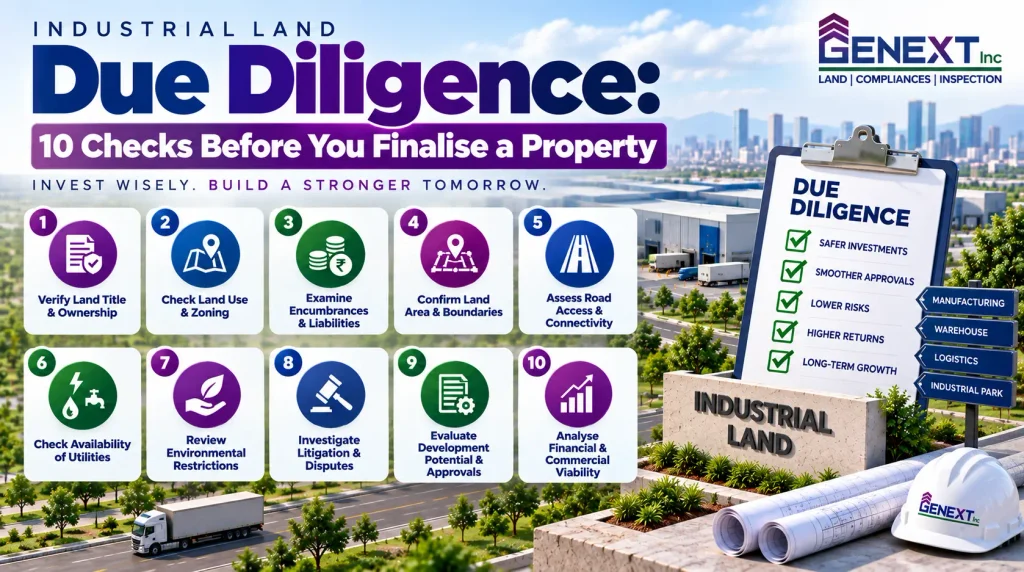
Industrial Land Due Diligence: 10 Checks Before You Finalise a Property
The purchase of industrial land is a very costly decision. Choosing the right parcel involves more than location and cost. This is especially important for industrial development projects.
This is where Industrial Land Due Diligence comes into play. Detailed due diligence can uncover ownership concerns and land-use limitations. It can also identify approval, access, and environmental issues.
Even a good paper can bring great legal, financial and operational problems if certain checks are neglected. When you’re about to finalise an industrial property, there are 10 important checks you should carry out.
1. Verify the Land Title and Ownership
Industrial land due diligence begins with establishing who is the legal owner of the land.
To verify the chain of ownership by checking title documents, sale deeds, previous ownership documents, mutation records and other documents. Our goal is to make sure that the seller has the legal authority to sell the land.
Check whether the property has multiple owners or inherited interests. Also look for conflicting records, disputes, or other inconsistencies.
A well-drafted and marketable title is the basis for a safe transaction.
2. Check Land Use and Zoning
Not all land is suitable for industry.
Before completion, check the development plan and local zoning framework. Also verify the property’s permitted land use. The land can be under agricultural, residential, commercial, industrial and controlled-area regulations, depending on where it is located.
If land use needs to change, check whether CLU approval is required. Also confirm that the proposed industrial activity is permitted.
Residential zoning violations may lead to delays in approval or cause the proposed development project to be legally unavailable.
3. Examine Encumbrances and Existing Liabilities
Even if the documents seem to be in order, there may be financial or legal claims against the property.
Ensure the land can be transferred without outstanding financial commitments. Also check for third-party claims.
One of the key issues is to make it clear that the land can be transferred without any outstanding financial commitments or any third party claims.
Before entering into the transaction, where needed, have the necessary legal confirmations and supporting documents.
4. Confirm the Exact Land Area and Boundaries
The descriptions of the area in a sales contract may not always reflect the actual conditions of the site.
Check the size of land and its khasra/ survey number, boundary and registered area with the official record and site inspection.
A professional survey may be used to determine encroachments, boundary conflicts, access problems or mismatches between the actual and recorded size and shape of the parcel.
For major industrial projects, even a small miss-match can cost a lot of money.
5. Assess Road Access and Connectivity
While location is an essential criterion for industrial real estate, being close to a highway doesn’t automatically mean it is well connected.
For a deeper understanding of how infrastructure connectivity can influence industrial land value and development, read our guide on How Expressway-Led Development Is Redefining Industrial Land Strategy.
Look at how dedicated the property is to the road, whether the approach to the road is adequate in width, and whether the right of way and connections to key roads, railways and local industrial estates are sufficient.
Access for heavy commercial vehicles is especially crucial for warehouses and manufacturing facilities.
Check if the approach road is legally recorded and if there are future plans for infrastructure which may impact access.
6. Check Availability of Utilities
A reliable infrastructure is a necessary of industrial operations.
Prior to completing the property, determine the availability and feasibility of electricity, water, drainage, sewage, telecommunications, and other necessary utilities.
Assess power capacity and availability and water supply needs.
If the development is larger, consider the estimated cost and time of bringing utilities on-site as well.
If a substantial investment is needed in the infrastructure after acquisition, the lower land price may not be appealing.
7. Review Environmental and Regulatory Restrictions
The need for environmental compliance is growing in importance for industrial projects.
Determine if the property is located in an environmentally sensitive area, restricted area, water body, forest related area, or other regulated area.
The proposed industrial activity also needs to be evaluated for compliance with relevant environmental and pollution control legislation.
Prior to embarking on construction or operation of a project, approval or clearance may be needed from relevant authorities, depending on the project.
The needs determined during industrial land due diligence can help to avoid potential regulatory ‘surprises’ later in the project.
8. Investigate Litigation and Disputes
Industrial land use is adversely impacted by legal conflicts, which also have an impact on the transferability of industrial land.
Look for present or past court cases involving the property, its owners, property boundaries, access rights or neighbouring properties.
Specifically focus on conflicts over inheritance, possession, partition, acquisition proceedings and easement and right-of-way claims.
A legal review should be used to see if any dispute has been identified in the process, which could impact ownership, development value or future sale.
9. Evaluate Development Potential and Approvals
So, it’s not just about simply buying the land. The key is whether the property is suitable for the development.
Examine relevant building ordinances, development controls, setbacks, ground coverage, floor area, height, etc., parameters.
Also, determine the potential approvals and licences that could be needed for the intended project.
The assessment of compliance requirements early on can enable a realistic development timeline and overall project cost to be estimated when developing industrial projects.
10. Analyse the Financial and Commercial Viability
The last test is if the property is commercially viable.
Don’t judge land just by the price it is in quotation. Registration fees, taxes, development fees, infrastructure costs, approval fees, utility connections, development site preparation, and potential compliance expense are some of these costs to consider.
Contrast the property compared to other industrial land in the market and determine the long-term appreciation and suitability of the property for operation.
The superior connectivity, clear documentation and relatively easy approvals from a bit more expensive parcel might end up providing more value than the cheaper parcel with some hidden issues.
Why Industrial Land Due Diligence Matters
The investment for industrial land transactions is a very large amount and commitments of time are made over the long term. One such error in acquisition can impact construction projects, the cost of the project, financing and future project operations.
Structured industrial land due diligence gives buyers more clarity before they enter into a sale agreement or make a major investment.
The process should ideally include a legal, technical, regulatory, environmental and commercial assessment, and shouldn’t be restricted to one document review for developers and businesses.
Final Thoughts
Don’t make the final decision on industrial land just on the basis of location or price alone. Whether a property is actually appropriate for industrial use is impacted by a variety of factors, including ownership, zoning, access, utilities, environmental restrictions, litigation, and development potential and financial viability.
For more insights on industrial real estate, land aggregation, infrastructure-led development and property strategy, follow Genext on Instagram and stay updated with our latest insights and updates.
