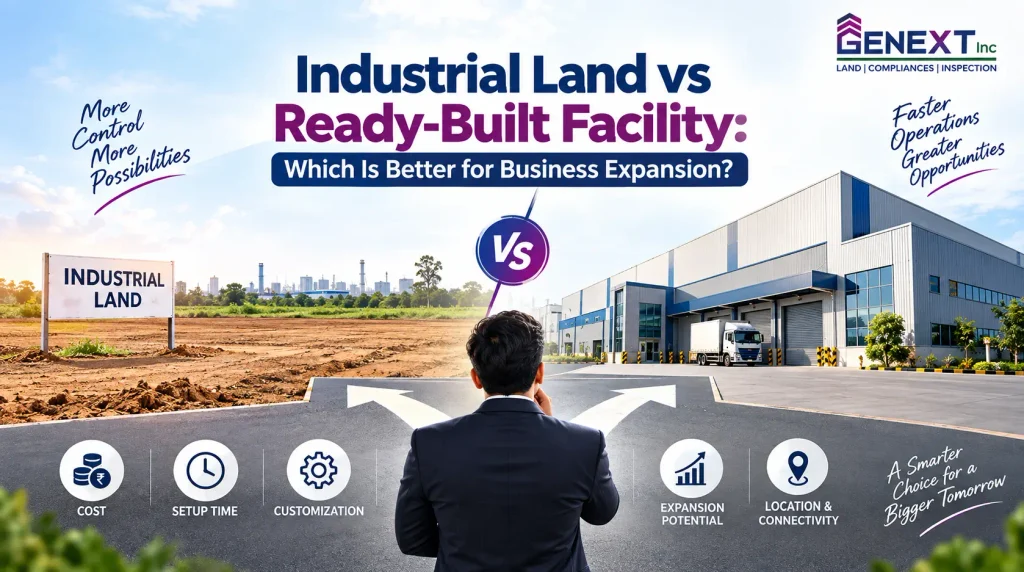
Industrial Land vs Ready-Built Facility: Which Is Better for Business Expansion?
Growth and expansion in business sometimes does not simply mean more space. The right industrial property can impact set-up time, capital investment, operating efficiency, and future growth.
There is no one right or wrong answer for a business when selecting between industrial land and a ready-built facility. It’s entirely up to you as to which one is better since it depends on your budget, production requirements, expansion plans, and future plans.
This industrial property comparison feature is designed to educate business owners and inLand, however, also provides more work. It’s a process that takes time and a lot of planning, approvals, contractors, financing, and projevestors on the differences between these industrial properties.
Industrial Land: More Control, More Responsibility
A plot of land that is zoned or approved for industrial use. It affords a business the flexibility to create and build a facility around its business operations.
The building, production layout, storage spaces, loading spaces, offices, and utilities can be designed based on your business.
However, choosing land also involves more work.
Developing the facility takes time and requires planning, approvals, contractors, financing, and project management. Businesses planning to acquire industrial land should also understand the key factors involved in selecting the right site for a manufacturing unit.
Ready-Built Facility: Faster Operations
A ready built facility is an established industrial building that is bought or rented for business. It can feature warehouse or factory space, offices, loading areas, utilities and other infrastructure, depending on the specifications.
This option can significantly reduce the setup timeline.
Having a suitable facility will enable a company to begin operations much earlier than developing a project from raw land. The trade-off is less customization. The building height, the spacing of columns, the strength of the floor, loading arrangements, the strength of power, and layout may not be exactly right for your operation.
Industrial Land vs Ready-Built Facility: Key Differences
1.Industrial Land vs Ready-Built Facility: Key Differences Cost
Sometimes, industrial land may seem more affordable because you’re only purchasing the site.
However, the total project cost also includes construction, site development, approvals, utilities, financing costs, and contingencies.
By comparison, a ready-built facility already has much of the physical infrastructure in place, but it may require a higher upfront property investment.
2. Time to Start
The advantage typically lies with ready built facilities. After legal, technical and operational checks are done, a suitable building can be occupied relatively quickly.
Design, approval, construction, installation, testing and commissioning are needed for industrial premises. This means that the timeframe may be extended considerably.
3. Customization
When there is a business with very particular needs, industrial land is the winner. The facility can be arranged for the machinery, flow, storage, employee safety, employee movement, and future capacity.
4. Expansion Potential
Industrial land can be attractive to companies that plan to expand.
Additional production lines, warehouses, parking, utilities, or future buildings may be accommodated within a well-planned site.
For a ready-built facility, expansion depends on available land around the building, regulations, lease terms, and local market availability.
5. Location and Connectivity
In both cases, location is important. Assess the suitability of highways, ports, terminals, suppliers, customers, labour and urban markets.
The industrial and logistics market in India is still active. The top eight cities combined had 36.9 million sq ft of industrial and warehousing leasing in 2025, representing a 16% increase from the previous year. The demand from Delhi NCR was 24% and Chennai was at 22%.
CBRE stated that H1 2026 witnessed nearly 60% share in terms of industrial and logistics leasing in the Delhi-NCR, Chennai, and Bengaluru region. This highlights the need to opt for a site suitable for the company’s supply chain and employees.
Which Option Is Better for Business Expansion?
Industrial land may be suitable if you have a long-term expansion plan, special design or heavy infrastructure requirements, and the ability to manage construction and approvals.
A ready-built facility may be preferable if you want to get up and running quickly, your requirements fit an existing facility, or you want to reduce construction risk.
Before Making the Decision
There is much more to this industrial property comparison than the advertised price of the property – it should begin with a complete financial and operational review.
Check:
- Purchase / Lease cost
- The cost of construction and fit-out.
- The costs for stamp duty, taxes and transaction costs.
- Power, water, drainage and other utilities.
- Accessibility by road and by truck.
- Fire and safety considerations
- Right of land ownership and land uses (as per applicable land-use permissions).
- Building approvals and compliance
- Cost of care and maintenance
- Future expansion capacity
- The ability to resale or exit.
When it comes to industrial land, check title, zoning and land-use, development permissions, access rights and local regulations before investing capital. There are varying requirements from state to state and industrial zone to industrial zone, so careful legal and technical due diligence is crucial.
Final Verdict
It’s not all about the type of properties, the better option is related to the business model.
Long-term development potential, control and customization of industrial land. A ready built facility will have quick turnaround, existing infrastructure, and may have reduced execution risk.
If the facility has high throughput and normal space needs, a ready-built facility might be a more practical option. Industrial land might have more strategic value to a manufacturer with a longer investment horizon and with specialized needs.
When choosing an industrial property for comparison, it is important to take all of these factors into account.
The purpose is NOT to get the lowest house. It is about discovering the property which is conducive to the profitable and sustainable expansion of business.
Follow Genextinc on LinkedIn for more insights on industrial land, industrial properties, manufacturing facilities, and business expansion.
