Why Manufacturing Companies Are Expanding Beyond Traditional NCR Industrial Hubs
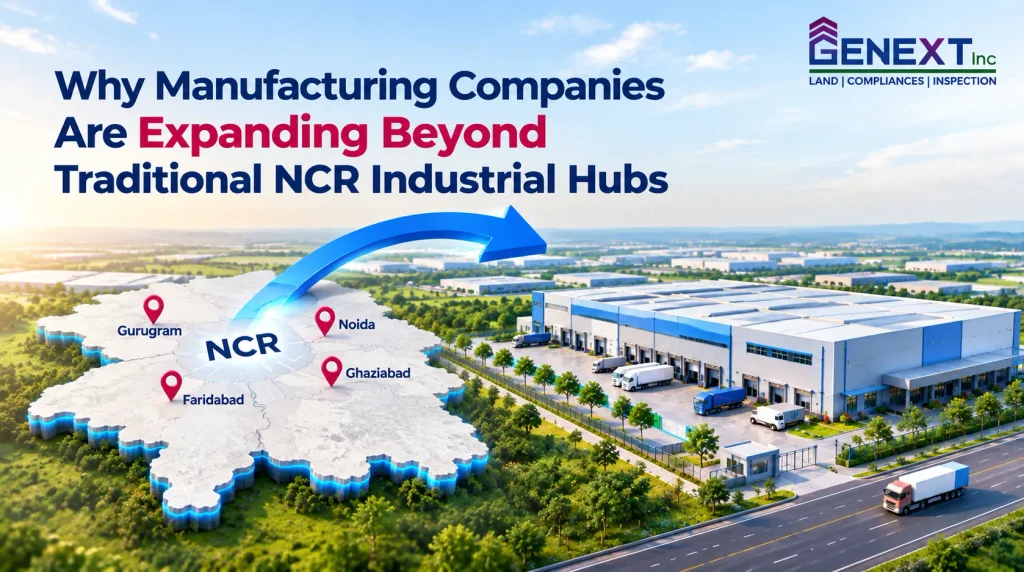
The National Capital Region (NCR) has been a significant region for industrial and manufacturing activity in India for decades. The strong infrastructure, skilled manpower, networks of suppliers and their convenient location in the major markets have helped established hubs in Gurugram, Faridabad, Noida, Greater Noida and Ghaziabad.
But the scene is changing in the industry. As land value and other development costs go up, along with traffic flow and a shortage of large, continuous parcels, companies are looking at sites outside of the traditional NCR clusters.
The change is ushering in new opportunities in the new industrial corridors of Haryana, Rajasthan, Uttar Pradesh and other adjoining areas.
Rising Pressure on Traditional NCR Industrial Hubs
Tried-and-tested industrial estates still provide many benefits, but the opportunities to expand within clusters are diminishing.
Rising land values in established NCR markets have been significant in some industrial markets. Meanwhile, businesses seeking territory for their manufacturing facilities or warehouses, or for a combination of the two, might have a problem in locating the right land with distinct ownership, zoning and infrastructure.
The other challenge is the growing load on the current infrastructure. Logistics efficiency and operation costs can be impacted by heavy traffic, urban development and competing residential/commercial projects.
For long-term expansion planning, as a result, businesses are considering areas with land availability, connectivity, infrastructure, and project economics that are in balance.
Why Manufacturing Companies Are Exploring New Locations
1. There is an increase in industrial land costs.
Geographical shift is one of the largest drivers for the reason of cost of industrial land. Developed and established NCR sites are likely to be more expensive due to their close location to the main markets, their infrastructure and other factors. Even a slight land cost disparity can make a big difference in the total cost of the project for companies with hundreds of acres.
Comparatively larger land parcels can be found at more competitive prices at emerging industrial locations so that the money can be channeled into plant development, machinery, technology and more operational needs.
2. Improved Infrastructure and Transport Linkages
No longer is industrial expansion restricted to near the Delhi or the central NCR.
New highways and expressways, logistics corridors and improved road networks link up new industrial business areas to major consumption centres and ports.
That enables companies to explore sites away from the major cities of the NCR and still have convenient access to suppliers, customers and distribution channels.
In the manufacturing industry, having a solid connection may be essential as it is connected to the cost of transportation and the time taken for deliveries.
3. Availability of Larger Land Parcels
In more developed industrial areas, it may be difficult to secure a large, single and legally defined parcel of land.
In a number of established sites, large plots are no longer available because of urbanisation and the absence of large parcels. For companies that are considering developing large industrial parks or integrated manufacturing plants, a larger parcel is often needed than is available in traditional industrial areas.
Emerging sites may offer increased opportunities for land assembly which in turn may allow the businesses to assemble appropriate parcels based upon the requirements of their project.
But, the aggregation of lands should be backed by proper verification of title, ownership check, land-use assessment and regulatory due diligence.
4. Lower Operating Costs
The cost of land is a single part of the overall cost of an industrial project.
Other factors that companies consider are labour, transportation and utilities, construction, taxes, warehousing costs, and the potential for growth.
Some of these costs could be optimised in more than one way at a location outside of the known NCR hubs. Cost of land, and the quality of infrastructure can make the new industrial location financially attractive over the long term.
The goal isn’t only about getting the lowest price for land. Rather, companies are seeking sites that offer the optimal mix of cost, connectivity and scalability.
5. Support for the development of emerging industrial corridors
Another important determinant of location is the development of new industrial corridors.
Businesses are turning their eyes to areas linked to transport infrastructure such as large highways, freight corridors, logistics hubs and expected industrial developments.
Growth in industries in various parts of Haryana and adjoining states has opened new opportunities for manufacturing, warehousing, automotive, engineering, food processing and other industries.
Having one of the first movers in a new industrial corridor can also give businesses more time to lock in land before it becomes more concentrated and land prices increase even more.
For companies planning long-term industrial expansion, land banking can also be an effective strategy to secure strategically located land before demand and prices rise. Businesses can learn more about this approach in our guide to Understanding Land Banking Strategies for Long-Term Industrial Growth.
Key Locations Emerging Beyond Traditional NCR Hubs
The industrial geography is moving away from a centralised form toward a more spread-out one around NCR.
Haryana is seeing businesses relocating to locations along major highways and along emerging industrial corridors. Sohna, industrial–logistics areas of extended influence of Manesar and other developing belts are being assessed for industrial and logistics needs.
Neighboring states are also increasing in importance. Large land availability and connectivity to major markets in Rajasthan and UP as well as cities and industrial locations along expressways and freight infrastructure can provide attractive alternatives to congestion in established markets.
Ultimately it will be determined by the needs of the industry; such as the size of the land, manpower, logistics, utilities, environmental conditions and regulatory approvals.
What Companies Should Check Before Expanding
While the location may present significant opportunity, there are other factors to consider beyond the cost of land.
Prior to finalizing a property, businesses should consider:
- Records of land title and ownership.
- Land use and zoning approvals.
- The industrial suitability of the location.
- Road and highway connectivity (15.3%)
- Availability of power and water
- Environmental and regulatory needs
- Approach roads/Logistics accessibility/
- There’s a chance of more land in the future.
- Poor accessibility to suppliers or key markets.Lack of access to suppliers or key markets.
- Plans for development and infrastructure for the surrounding area.
A thorough due diligence procedure can be used to help to uncover legal and regulatory risks, physical and commercial issues before a large investment is made.
The Future of Industrial Expansion Beyond NCR
The industrial development around NCR will tend to be more decentralised in the next phase.
Businesses can increasingly go for a corridor based growth strategy rather than focussing all their facilities in predefined industrial hubs. With this method companies can compare a variety of locations based on infrastructure, available land, logistics, and scalability.
In industrial markets, this transformation can present manufacturing firms with an opportunity to build bigger, more productive facilities and alleviate some cost pressures.
Meanwhile early planning is of growing importance. Companies can have a better chance of acquiring strategically located parcels if they are able to identify appropriate land and do due diligence before an area gets competitive.
Conclusion
This move by industries away from the traditional NCR hubs is indicative of a much more significant shift in the industrial real estate market in India.
Businesses are increasingly considering alternative industrial locations in response to the cost of land, availability of large tracts of land, infrastructure stress and new connectivity corridors.
Stay Connected With Genext Inc.
For more insights on industrial real estate, land acquisition, industrial expansion and property development, follow Genext Inc. on LinkedIn for the latest updates, market insights and industry perspectives.
