Haryana CLU Rules 2026: Process, Documents, Charges & Latest Updates
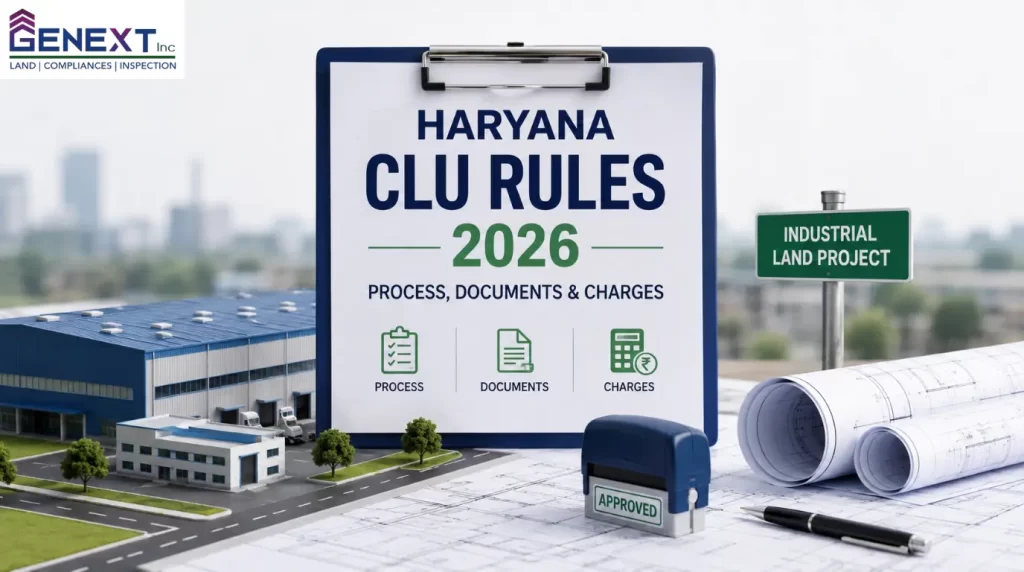
Haryana CLU Rules 2026:: The purchase of land for an industrial, warehouse, commercial or institutional project in Haryana is not only a matter of “right place” but it is also one of the right person. Businesses need to be aware of the types of land use rights that may apply, zoning regulations, required documentation and statutory approvals before they begin developing.
As the state has taken several steps to ease the process of obtaining land-use permissions and cut down on the requirements of compliance, the Haryana CLU rules have become significant in 2026. Over recent years, reforms have been made, such as decreasing files for Change of Land Use (CLU) permission from 19 to 3 and implementing auto-CLU in industrial areas.
Meanwhile, the Town and Country Planning Department (TCP Haryana) has been ongoing with the release of news on CLU, licences, building plans, occupation certificates and pending regulatory issues.
Being aware of these changes can help businesses minimize delays, make sure they comply with the regulations, and plan their projects more effectively when considering the acquisition of industrial land in Haryana.
What are the Haryana CLU Rules 2026?
CLU refers to Change of Land Use. Authorities require CLU approval when a business wants to use land for a different purpose than its existing or permitted land-use classification.
For instance, a business could acquire a parcel of land that has an existing land-use designation and intends to develop an industrial/commercial warehouse, institutional, or other project approved under that existing land-use designation. Businesses should consult the planning authority and review zoning regulations before starting development.
Businesses may need CLU depending on the property’s location, zoning, development plan, controlled-area status, proposed activity and applicable government policies.
Therefore, businesses cannot automatically use every land parcel for their intended project.
Latest Haryana CLU Rules 2026 Updates
There are significant changes in the Haryana CLU rules in 2026.
The Haryana government announced several reforms, one such change is that of CLU permission documentation. The government reduced the CLU documentation requirement from 19 documents to 3, according to reports on the reform measures. It also announced plans to introduce auto-CLU in industrial areas.
These changes aim to simplify the approval process and make it more business-friendly.
But the ease with which documents can be simplified doesn’t mean the companies are not obligated to perform land due diligence. Businesses must still assess other approvals, site suitability, access, infrastructure, development plan provisions, land ownership and zoning before investing.
Why Haryana CLU Rules 2026 Matter Before Buying Industrial Land
Businesses should consider CLU requirements before buying land, not after completing the purchase.
These attributes to a parcel may appear attractive due to its location, road access, size and cost. However, the property’s development potential depends on planning regulations and applicable land-use permissions.
An appropriate pre-purchase evaluation will assist in determining:
- Determine if the proposed land use is allowed or not
- It is not clear whether CLU applies to this situation.
- If the site is within a controlled area or not.
- If the proposed activity does not comply with the applicable zoning:
- If necessary, whether approach road and access conditions are met
- Whether any other permissions might be necessary
- Determine if there are delinquent dues and/or compliance concerns
- The geographic suitability of the project and land use for the industrial/commercial activity.
This is especially relevant for enterprises that buy up substantial property blocks for production facilities, warehouses, logistics facilities, institutional or commercial development.
For a broader understanding of land-use conversion risks, see our guide on Land Use Conversion Challenges Developers Must Prepare for in 2026.
Haryana CLU Rules 2026: Documents and Application Process
The recent reforms have simplified the documentation requirement, but applicants should always verify the latest checklist applicable to their specific project and authority.
TCP Haryana provides checklists and service information for CLU, building plans, and occupation certificates.
A typical CLU assessment involves the following stages:
1. Land and Ownership Verification
The first step is to verify the ownership and revenue records of the property.
The buyer should review the title documents, registration records, mutation details, site records, and other relevant land documents.
2. Zoning and Development Plan Check
Businesses should check the proposed site against the applicable development plan and zoning provisions.
This step helps determine whether the intended industrial, warehouse, commercial, or institutional activity is compatible with the planning framework.
3. CLU Applicability Assessment
Not every parcel requires the same approval pathway. The project’s location, existing land use, zoning, and proposed activity must be evaluated to determine whether CLU permission is required.
4. Application and Documentation
Where CLU is applicable, the applicant must submit the required application and supporting documents through the prescribed process.
The latest applicable checklist should always be confirmed before filing because government requirements can change.
5. Scrutiny and Departmental Requirements
The application may involve scrutiny of land records, site details, proposed use, access, planning parameters, and applicable charges or conditions.
Depending on the project, other statutory approvals may also be required.
6. Compliance Before Development
Obtaining land-use permission should not be treated as the final step. Businesses must identify all other approvals required before construction, operation, or commercial use of the property.
Haryana CLU Rules 2026: CLU Charges and EDC
The fees, charges and statutory payments associated with a CLU related project can vary, depending on location, land use, project type and regulations.
The price of a land purchase should not be the only indicator used to determine the exact amount.
For instance, in the Haryana official service information, scrutiny fee, EDC, conversion fee, and IDC (where applicable) are mentioned.
One more significant development in 2026 is the TCP notification dated 30 July 2026 for extension of one time settlement scheme “Samadhan Se Vikas-2021” for the recovery of long pending EDC dues in licence and CLU cases.
This is especially relevant to businesses that are considering existing properties that have been licensed and/or involves CLU.
A potential buyer should verify that the property he or she is interested in does not have any outstanding government dues, conditions or compliance requirements.
Auto-CLU in Industrial Zones: What Businesses Should Know
One of the interesting changes for 2026 is the rollout of auto-CLU in industrial areas.
The goal is to speed up the process of obtaining permits for allowed uses of eligible land and to minimize the need for needless procedures. The reform concerns specially industrial projects in designated areas.
Auto-CLU doesn’t mean that any industrial land parcel is approved, though.
Project eligibility and zoning, location, proposed activity, documentation and other regulatory requirements are still to be confirmed.
A professional land and compliance assessment can therefore help to identify if a specific property is indeed eligible for the simpler pathway.
Common Mistakes Businesses Should Avoid
Businesses can encounter challenges in the event land due diligence is not performed, even following the most modern improvements.
Some common mistakes include:
The purchase of land without consideration of what is allowed for it.
Even though the land is assumed as agricultural, it does not necessarily imply that it has to be used for that purpose.
Failure to abide by zoning ordinance and development plan requirements.
Failure to review existing EDC and/or other statutory dues.
Depending only on the seller’s information.
Not checking the road access and site conditions.
Focusing only on CLU as an approval process.
Failing to use accurate documentation or checklists.
Beginning construction before getting necessary permits.
It can cost more to fix up the issues after land acquisition than to do proper due diligence beforehand.
How Genext Can Help With Industrial Land & Compliance
If this is so, land acquisition and regulation compliance should be done simultaneously for businesses intending to expand their industrial projects in Haryana.
Genext can help businesses to identify industrial land, aggregate and secure it, and provides real estate compliance consultation services.
The goal is to assist clients to make an overall assessment of the property, both in terms of its location and price, and its development and compliance.
This can be very beneficial for manufacturing plants, warehouses, logistics facilities, institutional projects and other large projects.
Rather than land acquisition first, permissions second, businesses can perform a structured land acquisition process that includes a review of the land, the proposed use, approvals, and project feasibility.
Final Takeaway
The upcoming changes in the Haryana CLU rules in 2026 are designed to make the regulations even more business-friendly.In 2026, some key updates are planned for the Haryana CLU rules to further enhance their business-friendliness, particularly by streamlining documentation and approval processes. The changes in the documents from 19 to 3 CLUs and the addition of auto-CLU documents in industrial areas are important changes to consider for businesses looking to launch new projects.
Meanwhile, the latest reports on EDC dues, which have been pending for years in the state of TCP, highlight the necessity for financial and regulatory checks.
The proper way is straightforward for a industrial land buyer: ensure the land, examine zoning, know if the land is applicable for CLU, understand dues and compliance needs, and study the entire project approval method before purchasing the land.
By planning wisely and receiving professional advice, businesses can make better and informed land acquisition decisions, minimizing unnecessary regulatory risks.
In search of Industrial Land or CLU and Real Estate Compliance in Haryana? Genext can assist you to determine the land and regulatory needs prior to proceeding with your project.
For more updates on industrial real estate, land acquisition and regulatory compliance, follow Genext Inc. on LinkedIn.
