How Rail-Linked Logistics Parks Are Driving Demand for Industrial Land in India
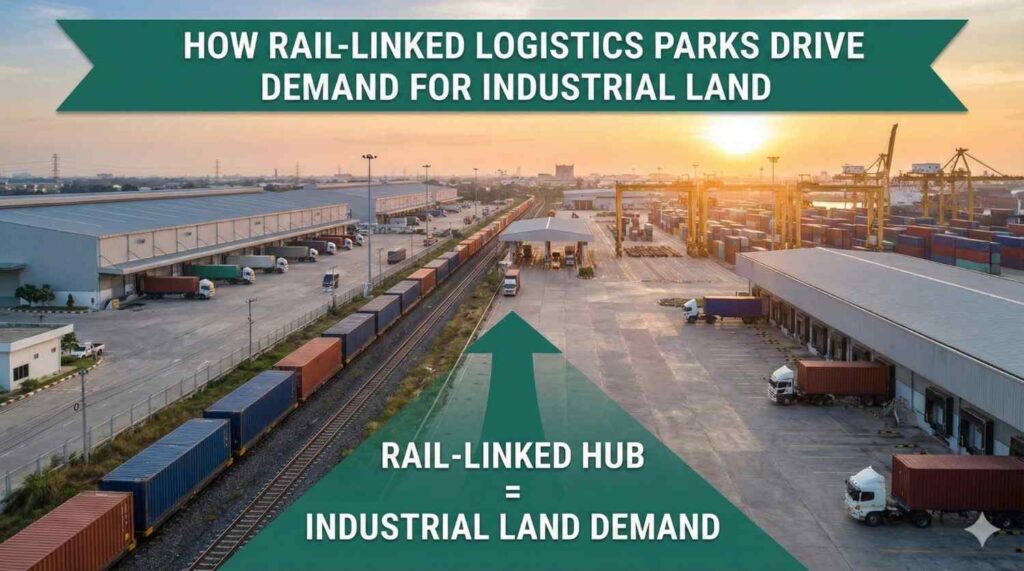
India’s logistics and industrial landscape is undergoing a rapid transformation driven by multimodal connectivity, the growth of e-commerce, expansion of industrial corridors, and new policy incentives. Among the many developments reshaping the industry, Rail-Linked Logistics Parks (RLLPs) are emerging as one of the strongest demand drivers for industrial land.
With the push for reducing logistics cost from 14% of GDP to a global benchmark of 7–8%, the Government of India is prioritizing rail-based freight movement, integrated logistics infrastructure, and seamless cargo flow. As a result, developers, institutional investors, and large industrial occupiers are increasingly seeking land parcels near railway terminals, freight corridors, and multimodal logistics hubs.
This shift is set to intensify further in 2025–2026. Here’s a detailed look at why.
1. Faster, Cost-Effective Freight Movement Is Increasing Rail Demand
Rail transport continues to be the cheapest mode of long-distance cargo movement in India. With Dedicated Freight Corridors (DFCs) now becoming operational in phases, freight trains can run at higher speeds with far greater reliability.
Benefits attracting industries toward rail-linked locations include:
- Lower per-ton transportation cost
- Reduced turnaround time
- Fewer delays compared to highways
- Priority movement for bulk cargo
- Better safety and lower pilferage
This makes rail-linked parks an ideal choice for FMCG, pharma, textiles, metals, automobile components, chemicals, and e-commerce companies that move goods across states regularly.
2. Government Push Through PM Gati Shakti & ULIP
Under the PM Gati Shakti National Master Plan, the central government is mapping and integrating railway infrastructure with roadways, ports, ICDs, and industrial corridors.
This directly benefits RLLP development in several ways:
- Identification of strategic nodes for logistics parks
- Faster approval coordination between ministries
- Incentives for private sector participation
- Better land availability around future freight hubs
- Integration with Unified Logistics Interface Platform (ULIP) for visibility
Developers increasingly prefer areas shown as logistics zones in the Gati Shakti portal to avoid land-use conflict and speed up regulatory compliance.
3. Dedicated Freight Corridors Are Creating New Hotspots
The Western DFC (Dadri–JNPT) and Eastern DFC (Punjab–Bihar) are unlocking enormous industrial potential in:
- NCR (Dadri, Greater Noida, Palwal, Rewari)
- Rajasthan (Alwar, Neemrana, Khairthal)
- Gujarat (Vadodara, Sanand, Palanpur)
- Maharashtra (Vapi–JNPT belt)
Land parcels located within 5–10 km of freight stations are witnessing rapid appreciation and strong pre-lease interest from:
- Logistics operators
- Cold chain companies
- 3PL players
- E-commerce fulfilment companies
- Export-oriented industries
4. Increasing Preference for Multimodal Logistics Parks (MMLPs)
The new-age RLLPs are not just rail terminals. They integrate:
- Rail sidings
- Truck terminals
- Warehousing clusters
- Container handling zones
- Value-added services like packaging, sorting, repair
- Cold storage
- EV logistics support
This reduces freight handling costs by 10–12% and improves efficiency.
As a result, land demand around proposed MMLPs (e.g., Nagpur, Bengaluru, Palwal, Chennai, Silchar, Jalna) is increasing significantly.
5. Rail-Linked Parks Are Reducing Load on Highways
Congested highways and state borders often cause delays. Rail-linked logistics hubs offer:
- Faster interstate transport
- Stable freight schedules
- Better reliability during monsoon or peak load
- Lower carbon emissions (important for global supply chains)
Companies with sustainability targets—especially export and ESG-compliant sectors—prefer industrial land near rail connectivity.
6. Shift in Industrial Location Strategy
Earlier, industries preferred highway-facing plots. However, the new trend is “rail + highway” dual connectivity, where businesses look for locations that offer access to both freight corridors and major road networks.
Key location preferences include:
- Within 10–15 km from expressways
- Within 5–7 km from freight lines
- Close to ICDs and PFTs
- Near major consumption centres
For a deeper understanding of how highway connectivity is influencing industrial land selection, read our guide on expressway-led industrial land strategy.
This dual-access strategy reduces supply chain risk and improves resilience.
7. Future Demand Outlook (2025–2030)
Based on current infrastructure development patterns, industrial land demand near railway-linked zones is expected to grow by:
- 25–30% in NCR and Western DFC region
- 18–22% in Eastern India (as EDFC expands)
- 30–40% around upcoming MMLPs
- 35%+ demand from 3PL and e-commerce occupiers
Institutional investors are also buying into this ecosystem because rail-linked logistics real estate offers long-term, stable returns.
Conclusion
Rail-linked logistics parks represent the future of India’s logistics and industrial infrastructure. They provide speed, cost-efficiency, multimodal access, and sustainability advantages that modern industries require. As freight corridors expand and logistics modernization speeds up, the demand for industrial land near rail nodes will rise sharply—especially across NCR, Western DFC, and major consumption markets.
Developers, land aggregators, and corporate occupiers must plan early, evaluate connectivity zones, and align projects with India’s multimodal logistics vision.
Stay updated with Genext Inc.’s latest insights on industrial real estate, land acquisition, and infrastructure development. Follow us on Facebook for regular updates.
