How Infrastructure Projects in Budget 2026 May Influence Land Aggregation Trends
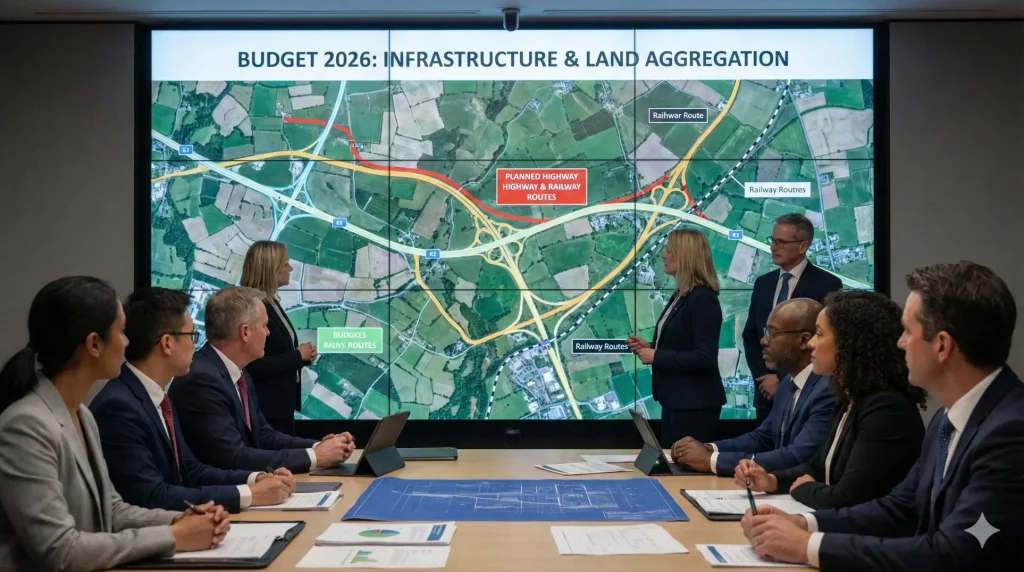
Infrastructure projects impact on land aggregation India’s Union Budget 2026 is expected to continue the government’s push toward large-scale infrastructure development—industrial corridors, expressways, logistics hubs, railway modernization, and multi-modal transport systems. Each of these interventions has a direct and measurable impact on land aggregation, especially in high-growth regions like NCR, Haryana, UP, Rajasthan, and parts of North India.
As developers, industries, and institutional investors continue to expand footprints, land aggregation has emerged as the only structured, scalable way to acquire large parcels efficiently. Understanding how upcoming Budget 2026 infrastructure allocations will shape land demand can help stakeholders take timely strategic decisions.
1. The Rise of Infrastructure-Led Land Appreciation
Historically, infrastructure investments such as the Delhi–Mumbai Expressway, Dedicated Freight Corridors, and new airports have caused 20–40% land appreciation in adjoining belts within 12–24 months.
Budget 2026 is expected to prioritize:
- Next-phase industrial corridor expansions
- Upgrading logistics parks into Multi-Modal Logistics Parks (MMLPs)
- Strengthening warehousing clusters around NCR
- Accelerating rural-to-industrial connectivity
- Funding for smart industrial townships
This will create new land aggregation hotspots, particularly where land consolidation aligns with planned corridors or logistics routes.
2. Expected Budget 2026 Announcements Linked to Land Demand
a. Expansion of Industrial Corridors
Existing corridors like DMIC, AKIC, EDFC, WDFC may receive new nodes or investment packages.
Impact:
- Businesses will rush to secure land before corridor alignment finalization.
- Aggregators will have higher responsibility in verifying titles, ownership clarity, and consolidation feasibility.
b. New Expressways & Greenfield Highways in NCR Belt
Upcoming proposals include:
- NCR Peripheral Expressway extensions
- UP & Haryana industrial-link highways
- Additional connectivity routes to MMLPs
Impact on land aggregation:
- Farmland along these alignments will witness early investor activity.
- Increased difficulty in consolidation as prices escalate after public announcements.
- Speed of aggregation becomes crucial.
c. Push for Tier 2 Industrialization
Budget 2026 is expected to allocate incentives for industrial development beyond primary hubs.
Cities likely to benefit include:
- Panipat, Karnal, Rohtak, Alwar, Neemrana, Ghaziabad, Palwal, Sonipat
Impact:
- Developers will require larger contiguous land banks for future factories, warehouses, and mixed-use industrial hubs.
- Aggregators must identify pre-notified areas and clusterable parcels early.
d. Support for Logistics & Warehousing
India’s logistics modernization will likely see increased funding for:
- Automated warehousing
- Cold-chain facilities
- Rural storage hubs
- Port-linked logistics
Impact:
Land aggregation will shift toward locations near:
- Freight hubs
- Rail terminals
- Wholesale distribution markets
- Cold-chain clusters
For a closer look at potential warehousing locations, see our guide to emerging hotspots for warehousing land in NCR in 2026.
3. Why Infrastructure Budget Influences Land Aggregation So Strongly
Infrastructure determines:
- Accessibility
- Industrial viability
- Logistics efficiency
- Future urban expansion
Therefore, lands near major government projects always become the first targets for consolidation by:
- Industrial developers
- Logistics companies
- E-commerce fulfillment operators
- Manufacturing firms
- Institutional investors
In Budget 2026, these trends will intensify.
4. Key Challenges in Land Aggregation Post-Budget 202
Developers must be prepared for:
a. Rising Land Prices
Budgets and blueprint announcements create speculative buying.
b. Ownership Fragmentation Issues
Many high-potential belts have multiple owners per acre, requiring professional aggregation.
c. Delays in Approvals & Change of Land Use (CLU)
High-demand zones typically face longer conversion timelines.
d. Due Diligence Challenges
Land parcels near new infrastructure often have:
- Overlapping revenue records
- Old disputes
- Incomplete mutation entries
- Need for GIS mapping validation
5. Opportunity for Developers: Pre-Budget Identification Strategy
Developers who act before Budget 2026 announcements can secure:
- Lower land entry prices
- Larger contiguous parcels
- Faster aggregation
- Better negotiation leverage
Highly strategic regions include:
- NH-48 belt (Delhi–Jaipur industrial corridor)
- Panipat–Karnal industrial expansion zone
Greater Noida–Bulandshahr warehousing arc - Palwal–Hodal logistics belt
- Rajasthan industrial pockets near NCR
Conclusion
Budget 2026 will play a transformative role in defining industrial growth patterns and land demand for the coming decade. With government investments aimed at boosting manufacturing, logistics, and mobility, land aggregation will become central to all large-scale development.Developers, industries, and investors must prepare early.
Professional land aggregators will play a crucial role in navigating ownership patterns, mitigating risks, and assembling viable large parcels aligned with future infrastructure growth.
For more insights on industrial real estate, land aggregation and infrastructure-led development, follow Genext Inc. on LinkedIn.
