Land Use Conversion Challenges Developers Must Prepare for in 2026
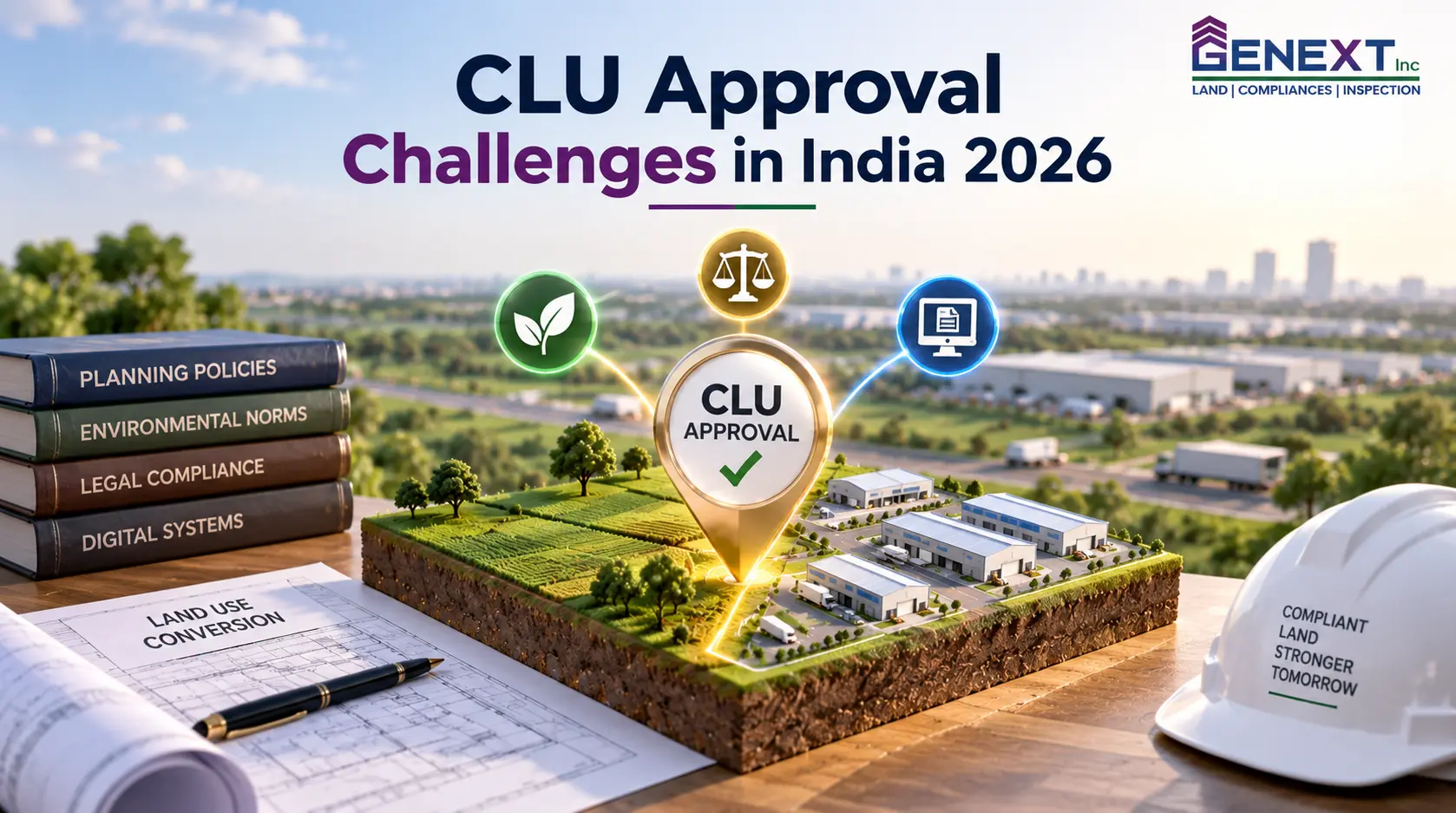
Land development in India continues to evolve rapidly, driven by expanding industrial corridors, accelerated infrastructure development, and increasing demand for integrated industrial and logistics parks. As developers move into 2026, one area that requires heightened attention is Change of Land Use (CLU) —a foundational step for ensuring legal compliance, financial predictability, and timely project delivery.
The regulatory framework for land use approvals is becoming more streamlined in some states, yet more stringent in others due to environmental mandates, digital verification systems, and urban planning reforms. This makes it crucial for developers, especially those planning industrial, logistics, warehousing, institutional, or mixed-use projects, to understand the emerging challenges and prepare proactively.
1. Increasing Scrutiny Under Updated Planning Policies
Across states like Haryana, Uttar Pradesh, Maharashtra, Rajasthan, and Punjab, planning departments have introduced stricter review of Change of Land Use (CLU) applications. In 2026, developers can expect:
- Deeper examination of the project’s alignment with the regional master plan
- More checks related to road width, access, and connectivity
- Cross-verification of ownership history and digital land records
- Mandatory adherence to zoning-specific activities
These measures aim to minimise unplanned development but may increase processing time if documentation or land title clarity is weak.
Developers should also review the latest Haryana Building Code 2017 Amendment 2026 requirements where applicable, particularly when planning industrial or large-scale development projects.
2. Compliance With Environmental and Sustainability Norms
With India’s renewed commitment to green infrastructure and lower carbon emissions, CLU approvals now integrate environmental assessments in more categories than before.
Developers should prepare for:
- Additional requirements related to groundwater impact, particularly for industrial and warehousing projects
- Mandatory Environmental Impact Assessment (EIA) for larger developments
- Conditions related to tree preservation, water recharge, and pollution control
- Possible restrictions near forests, wildlife zones, and agricultural belts
Ignoring or underestimating these environmental requirements can lead to delays, higher compliance costs, or rejection of applications.
3. Challenges Due to Digitalisation of Approval Systems
By 2026, most states aim to migrate completely to online, traceable approval frameworks with GIS mapping, automated scrutiny, and digital signatures.
While this improves transparency, it also presents new challenges:
- GIS-based land boundary conflicts may surface if older land records are inaccurate
- Any mismatch in khasra numbers, site coordinates, or encumbrance details may trigger objections
- Uploading incorrect documents or formats could cause system-based rejection
- Developers must align land documents with digitised state portals before filing CLU applications
Those who prepare documentation proactively will navigate the system more smoothly.
4. Rising Infrastructure Development Charges and Statutory Fees
Many state governments are revising external development charges (EDC), scrutiny fees, conversion charges, and compounding fees to align with updated infrastructure plans.
In 2026, developers should anticipate:
- Periodic revision of charges due to inflation-linked updates
- Differential fee structures for industrial vs. commercial vs. mixed-use projects
- Additional costs for access roads, drainage, electricity, and connectivity
- Higher penalties for non-compliance or unauthorized land use
Budgeting accurately for these charges becomes essential to avoid financial shocks during project execution.
5. Delays Due to Inter-Departmental Dependencies
Even though states aim to streamline approvals, CLU still involves multiple departmental checks:
- Town Planning Department
- Revenue Department
- Pollution Control Board
- Forest and Environment authorities
- Power, water, and road authorities
Developers often face bottlenecks when one department delays an NOC or raises objections.
In 2026, inter-departmental dependencies will remain a major challenge unless documentation and compliance are flawless.
6. Legal Disputes and Title Clarity Issues
A significant portion of land parcels in India still face:
- Title disputes
- Pending inheritance claims
- Mismatched survey records
- Unclear mutation entries
- Undisclosed encumbrances
Since digital systems now highlight discrepancies immediately, any such issue delays the CLU process.
Developers should invest in detailed land due diligence, physical verification, and legal vetting before buying or applying for conversion.
7. Restrictions Around Agricultural Land Conversion
Agricultural-to-industrial conversion remains one of the most complex transformations. In 2026, state authorities may tighten norms around:
- Loss of agricultural land in high-productivity zones
- Permissions near irrigation channels
- Conversion in environmentally sensitive belts
- Minimum road width and zoning alignment
Developers working on industrial parks and warehouses must account for stricter agricultural land-related conditions.
8. Non-Negotiable Compliance for Access and Road Width
Master plans have become more specific about:
- Minimum access road width to site
- Distance from highways or expressways
- Connectivity to major corridors
Any shortfall here can delay approvals significantly. Acquiring additional land for approach roads may be necessary in many projects.
Preparing for 2026: What Developers Should Do
To navigate the upcoming challenges smoothly, developers should adopt a proactive strategy:
✔ Conduct thorough land due diligence before acquisition
Ensure ownership history, land classification, mutation, and GIS coordinates match.
✔ Align projects strictly with the applicable master plan
Avoid applying for CLU if the land use contradicts the zoning.
✔ Prepare complete documentation in digital format
Scan, notarize, and prepare documents as required by the state portals.
✔ Invest in environmental and technical assessments early
This prevents objections from state authorities later.
✔ Engage experienced consultants and compliance teams
This helps reduce processing time and avoid errors.
✔ Budget for revised charges and variable fees
Stay updated on EDC, CLU charges, and infrastructure levies.
Conclusion
CLU is no longer a simple administrative process—it has evolved into a detailed, compliance-heavy exercise shaped by digital governance, environmental responsibility, and structured urban planning.
As developers move into 2026, preparing early, aligning with policy reforms, and strengthening documentation and compliance workflows will be the key to securing timely approvals and maintaining project viability.
For more insights on industrial real estate and regulatory compliance, follow Genext Inc. on LinkedIn.
