Top Factors to Consider When Aggregating Land for Industrial or Institutional Use
The demand for large-scale industrial parks, logistics hubs, and institutional campuses in India is rising rapidly. With government initiatives like the Delhi-Mumbai Industrial Corridor (DMIC), Gati Shakti, and state-level industrial policies, the need for large, contiguous land parcels has never been higher.
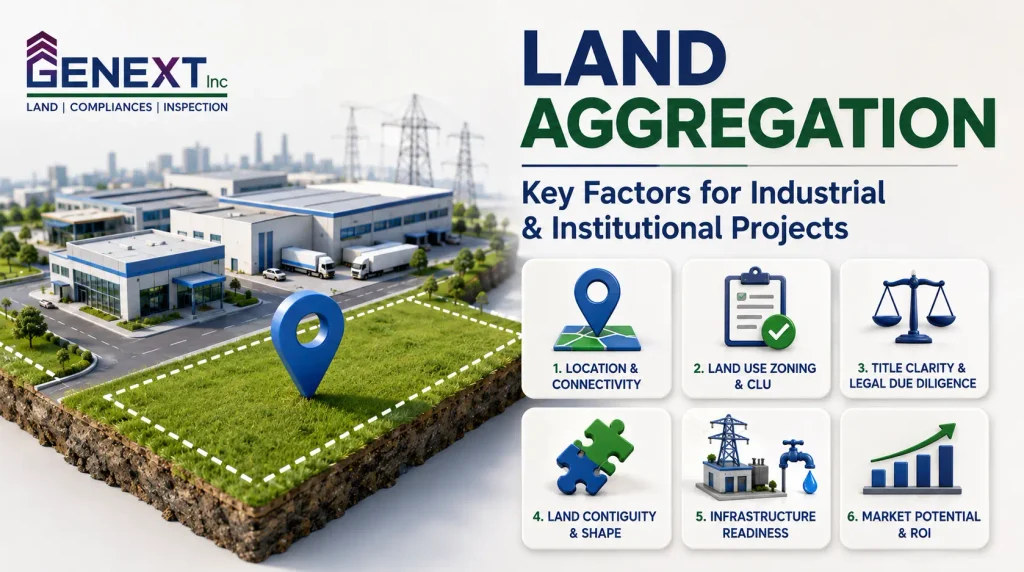
But securing such land isn’t as simple as buying from one owner. It requires a process known as land aggregation — the consolidation of multiple adjoining parcels into one large, ready-to-develop block. While the concept sounds straightforward, successful land aggregation depends on several critical factors that can impact both the feasibility and profitability of a project.
Here are the top factors developers must consider before aggregating land for industrial or institutional use.
🔹 1. Location and Connectivity
The first and most obvious factor is location. Industrial and institutional projects thrive when they are strategically placed near highways, ports, airports, or railway networks.
For developers evaluating warehousing opportunities in the NCR, understanding emerging locations and infrastructure corridors is equally important. Read our detailed guide on Emerging Hotspots for Warehousing Land in NCR 2026 to explore promising locations and future growth opportunities.
- For industries: Proximity to supply chains and distribution networks reduces logistics costs.
- For institutions: Accessibility for students, staff, and stakeholders is critical.
A well-located project not only attracts investors but also guarantees long-term viability.
🔹 2. Land Use Zoning & CLU (Change of Land Use)
Every parcel of land in India is designated for a specific purpose — agricultural, residential, commercial, or industrial. Before aggregating, it’s crucial to:
- Verify current zoning classifications.
- Apply for CLU (Change of Land Use) approvals where necessary.
- Align land use with state industrial or institutional policies.
Failure to comply with zoning can lead to costly project delays or even cancellation.
🔹 3. Title Clarity and Legal Due Diligence
One of the biggest risks in land transactions is title disputes. Developers must ensure:
- Clear ownership records.
- No encumbrances (mortgages, liens, or disputes).
- Consolidated legal documentation for the aggregated parcel.
Professional due diligence at this stage avoids litigation and future headaches.
🔹 4. Land Contiguity and Shape
For industrial or institutional projects, the shape and contiguity of land matter as much as size. A large, continuous block is easier to design, plan, and develop compared to fragmented parcels spread across a region.
- Aggregators often prioritize plots that connect seamlessly.
- Oddly shaped parcels can reduce usability and increase construction costs.
🔹 5. Infrastructure Readiness
Before finalizing land aggregation, assess whether the site has or can support basic infrastructure:
- Roads and internal access points.
- Power supply and substation connectivity.
- Water sources and sewage disposal systems.
Infrastructure readiness directly impacts development timelines and budgets.
🔹 6. Regulatory Approvals
Large projects require multiple clearances such as:
- Environmental clearance.
- Fire safety approvals.
- Consent to Establish (CTE) and Consent to Operate (CTO).
- State Industrial Development Corporation approvals (if applicable).
Planning for these early ensures smoother execution once land is secured.
🔹 7. Market Potential and ROI
Finally, land aggregation should align with demand trends. Developers must consider:
- Demand for industrial parks in the region.
- Proximity to anchor industries (like automotive clusters, pharma hubs, etc.).
- Government incentives (like tax breaks or subsidies).
The return on investment is ultimately what makes aggregation worthwhile.
✅ Conclusion
Land aggregation is more than just putting parcels together — it is a strategic process requiring due diligence, legal expertise, and market foresight. For industrial and institutional projects, success lies in selecting the right location, ensuring compliance, and creating ready-to-develop land banks that attract both investors and occupiers.
By focusing on these critical factors, developers can minimize risks and maximize the potential of their projects in India’s fast-growing industrial and institutional sectors.
Stay Connected with Genext Inc.
Follow Genext Inc. on LinkedIn for the latest insights on industrial real estate, land aggregation, regulatory compliance, land acquisition and infrastructure development.
Stay Connected with Genext Inc.
Follow Genext Inc. on LinkedIn for the latest insights on industrial real estate, land aggregation, regulatory compliance, land acquisition and infrastructure development.
