5 Real Estate Approvals Businesses Should Check Before Starting a Project
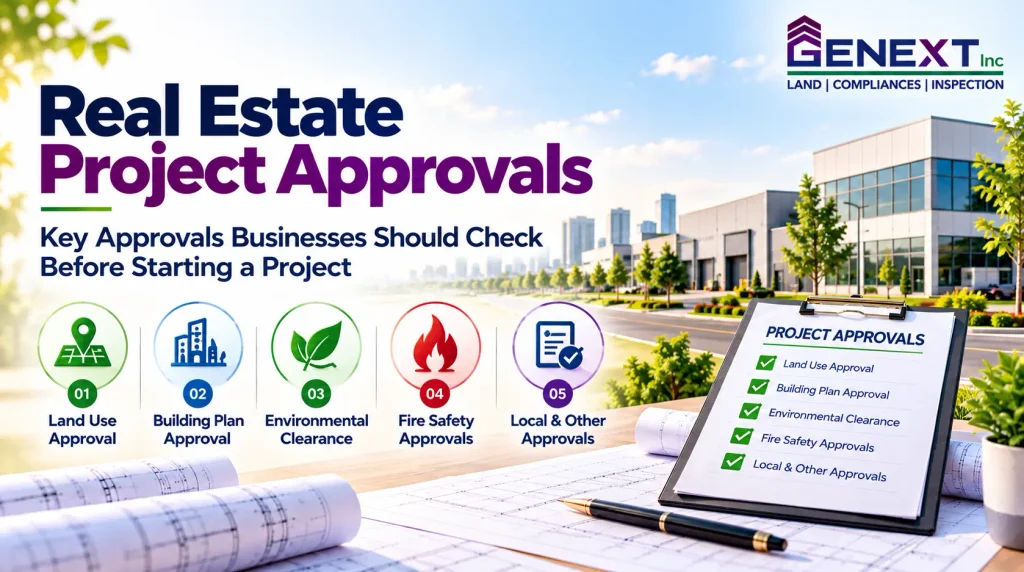
Real estate project approvals are essential before starting a real estate or industrial project, as businesses must comply with planning, environmental, building, fire safety and local regulations. Businesses must ensure that their proposed projects comply with planning, environmental, building, fire safety and local regulations. If an approval is missed, construction delays, extra costs or penalties can result, or obtaining subsequent approvals may be difficult.
Approval for each project type, location, land use, size and applicable state and local regulations varies. Before beginning a project, however, businesses should check on the following five key areas of approval.
1. Real Estate Project Approvals: Land Use and Change of Land Use Approval
The first one is making sure that land is available for the proposed project and is legally available.
An applicable master plan, development plan, zoning regulation or planning scheme typically determines how businesses can use a land parcel. For instance, areas zoned for agriculture might not be readily appropriate for an industrial or commercial/warehouse building.
If a change of permitted land use is required the business may need to apply for Change of Land Use (CLU) approval or the appropriate permission from the competent authority.
Before finalising a site, businesses should also evaluate connectivity, infrastructure, land suitability and future expansion potential. Read our guide on how to find the right location for a large industrial project to understand the key factors involved in site selection.
Businesses should check:
- Existing land-use classification
- The following are allowed on the site:
- Appropriate zoning and development regulations
- Determine if a CLU or another type of land-use permit is necessary
- Conditions imposed on the proposed use of the land
Early land use check can help businesses make an investment that will not be wasted on a land use that cannot be legally completed as the project.
2. Real Estate Project Approvals: Building Plan Approval
After a proposed use has been determined, the businesses should review the guidelines for building plan approval.
A building plan typically illustrates the development that is being proposed; consists of building layout, site planning, access, setbacks, floor areas, parking and other relevant information. The competent local or planning authority reviews the proposal against applicable building regulations and development controls.
Requirements can vary from project to project and may include Permissible Floor Area Ratio (FAR), setback, height limits, parking requirements, access and structural or building safety requirements.
Relying on a preliminary drawing of the architecture should not be the basis for beginning business. Construction should not take place until approval or permission is granted for the project being built.
3. Real Estate Project Approvals: Environmental Clearance and Permissions
Some projects require environmental permissions or environmental clearance before construction or development begins.
The requirement will depend on the type and size of the project, and the environmental regulations which apply. Some projects might be covered under the Indian environmental assessment framework.
Further, depending on the project, the business could require air emission, water pollution, waste management, groundwater, or other environmental-related permissions and/or consents.
It is therefore advisable for businesses to undertake an early environment assessment of the project to identify the appropriate permissions that may be relevant. Beginning work without an essential environmental approval can pose large regulatory and financial hazards.
4. Fire and Life Safety Approvals
Another key area of approval is fire safety, especially for warehouses, factories, commercial buildings and other structures that have high numbers of occupants or high fire hazards.
Depending on the building and local requirements, businesses may need to obtain fire safety approvals from the competent fire authority.
These requirements might include fire escapes, emergency access, fire-fighting systems, water storage, alarms, extinguishing equipment, emergency evacuation plans and more.
Fire Safety should not be an after-thought in the design of a business. Future “expensive” changes and delay in approval can be avoided through early planning.
5. Sectional and local approvals
There are other approvals, in addition to the four listed above, that are needed on many projects. These rely a great deal on the size, location, industry and operations of the project.
For instance, an industrial project could need approvals or registrations for operations, pollution control, electricity, water, road access, hazardous materials or other operating needs.
Local authorities or utility agencies may also require businesses to obtain permission for specific development or operational activities before starting a project.
How to Check Real Estate Project Approvals Before Construction
Before getting started, it’s a good idea for businesses to double-check some of the approvals that are in place.
Approvals are interconnected. Each of the approvals could impact other approvals, construction timelines, financing, vendor commitments and the anticipated project launch date.
The right pre-project approval review assists companies:
- Ensure regulatory needs are identified at an early stage
- Minimize the likelihood for expensive delays
- Know what projects are feasible before investing.Be aware of project viability before investment.
- Create plans and timelines
- Don’t undertake activities without the necessary permits
- Enhance co-ordination between consultants, architects, contractors and authorities.
Conclusion
Businesses should view regulatory approvals as a component of project planning, not paperwork after the construction is underway, before launching a real estate or industrial project.
Businesses should assess their project’s location and characteristics to identify the applicable land use or CLU requirements, building plan approvals, environmental permissions, fire and life safety requirements, and sector-specific approvals.
A general approval assessment at the start can assist companies to know what permissions they want, what they might encounter and how they can better plan the project. Approval can differ based on state, authority and project type, so please check the requirements for your specific project.
Follow Genext Inc. on LinkedIn for more insights on industrial real estate, project approvals and compliance.
