7 Factors Businesses Should Check Before Buying Industrial Land
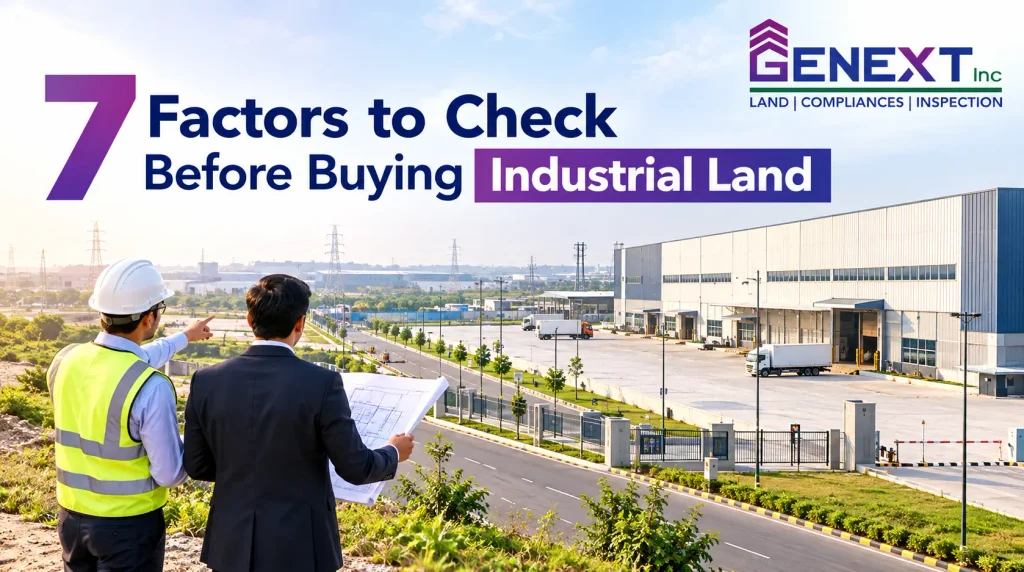
The purchase of industrial land is an important business decision. Legal and zoning challenges, infrastructure deficiencies and environmental contamination can cause major delays and extra costs, while the right parcel can enable efficient operations, expansion and long term asset value. Before buying land in India for industrial use, businesses should perform legal, technical, commercial and regulatory due diligence. Before buying industrial land, here are 7 factors you should take into account.
1. Verify Land Title Before Buying Industrial Land
The first thing to be established is the seller’s clear title and ability to transfer title to the person who is purchasing the home. The buyers must look at the sale deed, previous property deeds, revenue record, mutation record and other important documents.
Also, be sure that there are no mortgages, liens, court issues, acquisition notice, or other encumbrance on the property. The National Single Window System says that industrial licencing land should be clear of encumbrances, backed by documents that define the industrial land use, if required.
A legal due-diligence procedure may be able to uncover ownership or documentation issues before the closing of the sale.
2. Check Zoning and Permitted Land Use
A planning application for an industrial development can be physically acceptable but not acceptable under planning regulations.
Businesses need to check the land-use classification and zoning of the site, the development plan and allowed industrial uses. Where applicable, buyers should also determine if a Change of Land Use (CLU) is required or if any other permission for land-use is required.
When an industry is not in an area of established industry, permission for land use is listed as an important approval in government guidelines for new industrial projects.
Ensure that proposed manufacturing, warehouse, logistics or other industrial activity will be allowed on the particular parcel before buying.
3. Assess Location and Connectivity
Location impacts transportation expenses, employee accessibility, supply chain and customer or supplier movement.
Identify the connection of the land to:
- National and state highways.
- Highways and express highways
- Railway facilities
- Airport and Logistics Centers
- Ports, where relevant
- Nearby industrial clusters
- Labour and supporting services
India Industrial Land Bank offers businesses GIS enabled data on industrial parks, infrastructure, connectivity, terrain and industrial plots available in industrial locations across India.
The goal when buying industrial land isn’t just to find cheap land, but to choose a location that suits the business model.
4. Check Infrastructure and Utility Availability
Infrastructure is essential for an industrial operation. Commercial tenants need to ensure the site has sufficient electricity and water supplies, drainage, sewage, roads, telecommunication and waste-management facilities prior to making a purchase.
In manufacturing units which have a continuous production and machinery requirement, power availability is of particular importance. Likewise, poor road access can make transportation more time consuming and costly.
Avoid just taking people’s word for it. Check with utilities, approved capacity, connection requirements and applicable charges with the appropriate service providers or authorities.
5. Review Environmental and Pollution Requirements
Industrial activities, whether conducted on an individual or regional basis, can have widely different environmental requirements due to the nature of the activity, its location, size and potential environmental effects.
Businesses should also understand whether green belt requirements or other environmental planning considerations may affect the development potential of the site. For more information, read our guide on Green Belt Policy in India.
The decision of whether or not a proposed project requires Environmental Clearance, Consent to Establish (CTE), Consent to Operate (CTO), waste-management permissions, and other environmental approvals should be made by businesses.
For instance, the Haryana State Pollution Control Board said that those industrial units which are applicable, then they are required to obtain consent under water pollution and air pollution laws and industrial activities are categorised for use of consent.
Thus, land should be purchased first of all to see if it is environmentally feasible, not after construction or investment has begun.
6. Examine Physical Suitability of the Plot
Having the land approved in law is not sufficient to make it suitable for use. Do a physical and technical evaluation of the site.
Check:
- The real size and perimeter of the plot.
- Site access and road width.
- The water level and drainage of the land.
- Soil and ground conditions.
- The risk of flooding or water logging.
- Setback requirements
- Construction potential
- Opportunities for future extension
The available land area may not be the land area shown due to setbacks, access, required open space, utilities or other planning considerations.
Businesses can learn about the property’s true development potential through a proper site survey and technical assessment.
7. Calculate the Total Cost Before Buying Industrial Land
Costs to Consider Before Buying Industrial Land
Purchase price is just a single component of your investment. Cost of “putting the land into use” should be computed for businesses.
Other project related expenses can include registration and statutory fees, development costs, boundary walls, internal roads, utility connections, building construction, approval costs, environmental compliance, drainage and other infrastructure.
Businesses should also consider the future possibilities of the land, and the costs to regulatory or infrastructure needs.
A detailed feasibility study can thus give a more accurate picture whether the proposed industrial land is within the company’s budget and operation plans.
Conclusion
There are more to consider when purchasing industrial land as opposed to simply the price and location. Businesses need to confirm the title, land use, connectivity, infrastructure, environmental specifications, physical viability and project cost before deciding to purchase.
A well-structured due diligence process may enable identifying potential legal, regulatory, technical and financial matters early. For industrial projects, there are legal, technical, environmental and regulatory professionals that can be consulted to understand the approvals that are applicable to the proposed activity and to the location.
For more insights on industrial land, approvals, compliance and real estate development, follow Genext Inc on LinkedIn.
