How Haryana Industrial Policy 2026 Is Changing Industrial Land Demand
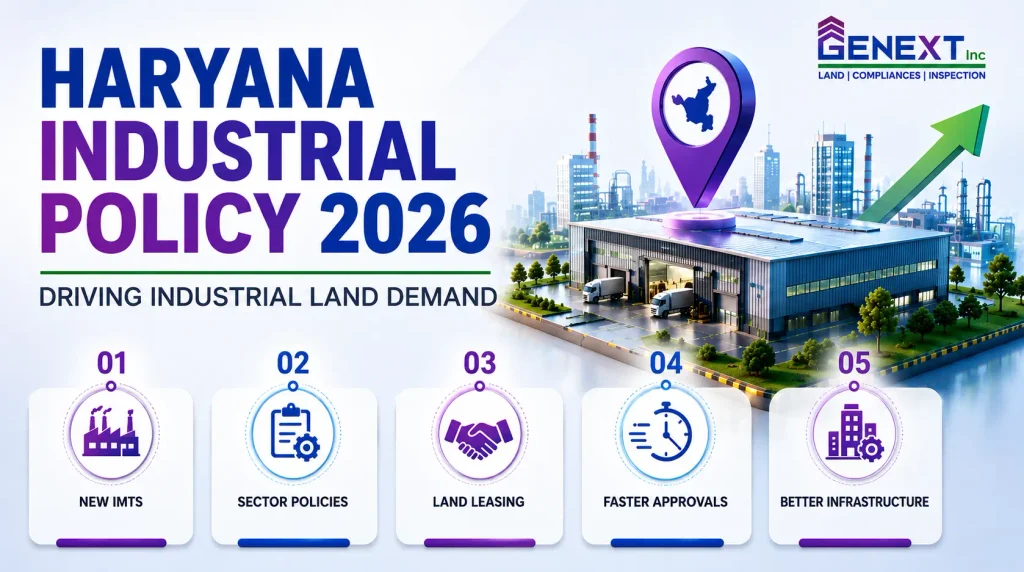
Haryana Industrial Policy 2026 now has a new era of industrial development as the Haryana Industrial Policy 2026 is released officially named ‘Make in Haryana Industrial Policy 2026′. The new policy replaces the previous Haryana Enterprises & Employment Policy 2020 and aims to strengthen the state’s position as a preferred location for manufacturing, technology, logistics and other emerging industries.
One of the most significant impacts in the real estate market is the possible change in the demand for industrial real estate. The demand for strategically located industrial parcels is continually changing due to the emerging need for new industrial townships, policies focused on specific industries, better investor facilitation, long-term lease deals and simplified land-use procedures.
What Is Haryana Industrial Policy 2026?
The Haryana Industrial Policy 2026 offers a new paradigm for investment inflow and facilitation for promoting industry and building an industrial ecosystem in the state. The government has also implemented policies specific to the electronics sector, pharmaceuticals and medical devices, GCCs, IT/ITeS and AI, data centres, agro-processing, toys and sports equipment etc.
The overall goal is to stimulate investment and to stimulate employment, develop infrastructure and to make the approval of businesses faster and easier.
For landowners, developers and industrial investors, this translates to the growing consideration of where a piece of land is located, its connections, its land use, its infrastructure and its suitability for future industrial development.
Why Industrial Land Demand Is Expected to Increase
The government is planning to develop the industrial infrastructure, which is one of the most important drivers. Haryana has announced 10 new Industrial Model Townships (IMTs), and the government is already advancing some of them. The government has also used the e-Bhoomi portal to earmark land for proposed IMTs in Jind, Rewari, Faridabad, Rai and Tosham.
The creation of these industrial areas may generate demand for several types of land such as manufacturing land, warehousing sites, logistics facilities, ancillary units, and supporting commercial facilities.
The KMP Expressway is also likely to remain an important industrial corridor, with three proposed IMTs located within the National Capital Region and connected to it. The Haryana Industrial Policy 2026 is expected to further influence demand for strategically located industrial land.
Shift Towards Strategic and Aggregated Land Parcels
Developers and investors are becoming more interested in parcels that are contiguous in size rather than small parcels that are scattered.The need for a contiguous parcel, as opposed to multiple small parcels, is growing in the face of larger and more specialized industrial projects. The Haryana Industrial Policy 2026 also increases the importance of well-connected and suitable industrial land parcels.
This is especially important for manufacturing plants, warehouses, logistics parks, data centres, institutional facilities and large scale industrial campuses.
In a new policy landscape, the value of industrial land is likely to be influenced by the following:
- Road & expressway connectivity
- Close to industrial areas
- Availability of utilities
- Land-use permissions
- Size of the parcels and contiguity.
- Environmental considerations
- Development potential
- Lack of access to labour and supporting infrastructure
This opens the door for professional land aggregation and procurement firms that can discover, assess and amalgamate ideal parcels for industrial ventures.
Land-on-Lease Can Change the Industrial Real Estate Equation
Another key development is the proposed Land on Lease Policy via HSIIDC. The initiative aims to expand industrial land availability while reducing the initial capital outlay for industries. The government has also indicated its willingness to convert leases into freehold industrial plots, subject to applicable conditions. The Haryana Industrial Policy 2026 also introduces a changing approach to industrial land availability.
This can affect the demand for industrial land in two ways.
For one, companies may not want to purchase land but opt for a long-term lease instead because of the financial benefits. Second, investors might be more inclined to put their money in areas where industrial facilities exist.
Therefore, industrial real estate demand may trend away from “buying the land” to considering the cost and suitability of the land as a whole.
Faster Approvals Can Increase the Value of Suitable Land
To create an industrial project, land is only a part of the equation. Project timelines can be heavily impacted by the approvals, land-use permits and environmental considerations, as well as infrastructure readiness.
The Haryana government is taking measures to simplify land-use and industrial approvals. The 2026 policy introduces several provisions, including reduced documentation for CLU permissions and Auto-CLU for industrial zones. Changes have also been made in the aspects of industrial land use, plot management and subdivision.
The government has also introduced a Land Feasibility Certificate Scheme that allows investors to obtain a land certificate and gain greater clarity on construction and environmental clearances.
Such measures may render industrial parcels more appealing to investors, from a legal and technical perspective.
Which Areas Could Benefit?
The demand for industrial land is not likely to be uniform in Haryana. Major highways, expressways and known industrial areas, developing IMTs are likely to be receiving more attention.
Gurugram and Manesar continue to reap rewards from their automobile and technology and corporate ecosystem. While Faridabad is significant for engineering and manufacturing, Sonipat, Rewari, Panipat, Karnal and other districts have their own advantages of engineering and logistical industries.
Increased relevance may also be found for emerging industrial locations as new infrastructure and industrial townships will be built.
Investors should thus consider not the cheapest piece of land, but rather the land that is well-suited for industrial use and has development potential going forward.
What This Means for Landowners and Investors
Professional land evaluation can help investors avoid parcels that appear suitable but later create approval or development challenges. The new policy landscape offers opportunities to landowners and industrial investors.
The land may attract more interest for landowners with strategically located land parcels if the land is appropriate for development by industry and is compliant with relevant planning and regulatory considerations.
The investors, on the other hand, should conduct thorough compliance due diligence before purchasing an industrial property. This should include verification of the title, land use status, zoning, access road, development plan considerations, CLU requirements, environmental constraints, utilities and surrounding industrial infrastructure.
The Bigger Picture
The benefits of Haryana Industrial Policy 2026 go beyond incentives offered by the government. Its bigger meaning is the emergence of an ecosystem of industrial investment, infrastructure, land availability and regulatory facilitation.
The government’s investor outreach in recent times also reflects its ongoing efforts to promote Haryana as an ideal destination for investments and industries. In a recent investor event in Mumbai, the state showcased its sectors like automotive, engineering, electronics, logistics, IT services and agro-industries, besides talking about its industrial infrastructure and investor facilitation measures.
This may mean increased demand for well-connecting land parcels that are compliant and are ready for development in the industrial real estate market.
Conclusion
Haryana Industrial Policy 2026 is giving a new shape to the industry development process, which is expected to directly affect the land market. Together, new IMTs, sector-specific investment policies, long-term land leasing, plug-and-play infrastructure and streamlined approvals can drive demand for strategically located industrial land.
If companies are considering expanding, it is important to make sure the land is available and compliant with legal requirements, as well as connected and appropriate for the project.
The evolving industrial environment gives landowners and developers opportunities to identify suitable parcels for manufacturing, warehousing, logistics, technology and institutional projects.
In a changing market scenario, early identification, aggregation and feasibility study and regulatory due diligence will prove to be valuable assets for the investors wanting to be a part of the next industrial development of Haryana.
Stay updated with the latest developments in industrial real estate, land, compliance and infrastructure by following Genext Inc. on LinkedIn.
