How Expressway-Led Development Is Redefining Industrial Land Strategy
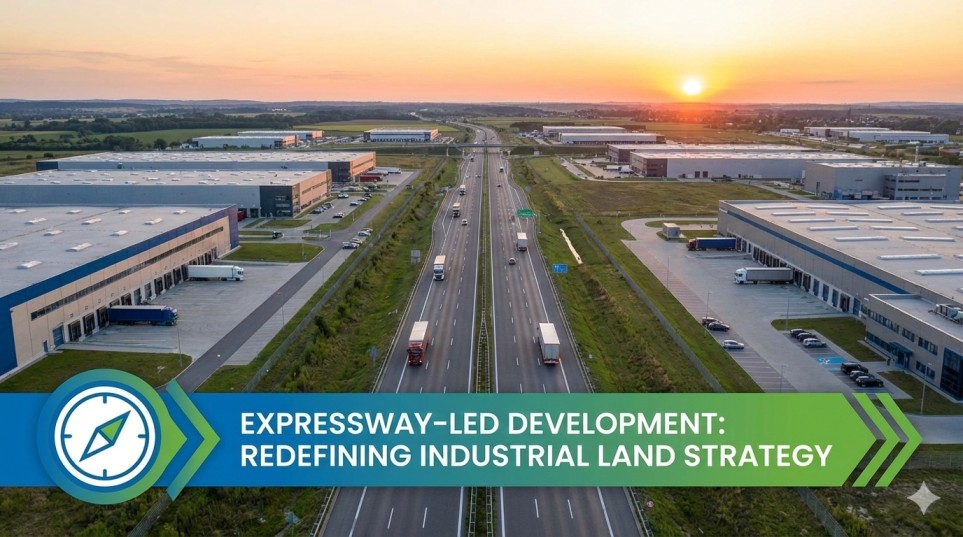
India’s rapid infrastructure expansion is no longer limited to railways, ports, or urban metros. Expressway-led development has emerged as one of the most powerful drivers reshaping industrial land demand across the country. From logistics parks and manufacturing hubs to data centres and warehousing clusters, expressways are redefining where and how industries choose land.
Major corridors such as the Delhi–Mumbai Expressway, Dwarka Expressway, Yamuna Expressway, Amritsar–Jamnagar Expressway, and Bengaluru–Chennai Expressway are transforming previously underdeveloped regions into high-potential industrial zones.
1. Why Expressways Matter for Industrial Development
Expressways reduce travel time, improve freight efficiency, and enable seamless movement of goods between production centres, consumption markets, ports, and airports.
For industrial users, this translates into:
- Faster supply chain cycles
- Lower logistics costs
- Predictable transit timelines
- Wider market reach
Land located within 5–10 km radius of expressways is now considered premium for industrial and logistics use.
2. Shift in Industrial Location Preferences
Earlier, industries preferred land within city limits or established industrial estates. Today, the strategy has shifted toward expressway-adjacent zones, driven by:
- Larger land parcel availability
- Lower acquisition costs compared to urban land
- Easier compliance for industrial zoning
- Scope for scalable expansion
This shift is especially visible in NCR, Haryana, Rajasthan, Gujarat, Maharashtra, Tamil Nadu, and Karnataka
3. Expressways Fuel Warehousing & Logistics Growth
Expressway connectivity is critical for:
- E-commerce fulfilment centres
- FMCG distribution hubs
- Pharma cold chains
- 3PL and 4PL logistics parks
Developers are now planning Grade A warehouses with expressway access to reduce first-mile and last-mile delays.
4. Impact on Land Aggregation Strategy
Expressway-led growth has increased demand for large, contiguous land parcels, making land aggregation more strategic than ever.
Key considerations include:
- Multiple landowners along corridor alignments
- Future right-of-way expansions
- Access road width and connectivity
- Compatibility with master plans
- Long-term zoning stability
Aggregated land near expressways commands higher investor interest due to scalability and exit potential.
5. Compliance & Approval Dynamics
Industrial land near expressways must meet stricter regulatory requirements:
- Change of Land Use (CLU) alignment
- Environmental and pollution control clearances
- Access approvals from highway authorities
- Fire safety and infrastructure NOCs
- Local master plan conformity
Projects planned without compliance foresight face delays despite prime location advantages.
6. Rising Investor & Institutional Interest
Private equity firms, REITs, and institutional investors increasingly prefer expressway-linked assets because they offer:
- Predictable appreciation
- Strong leasing demand
- Infrastructure-backed value growth
- Lower operational risk
Expressway adjacency has become a core investment filter.
Conclusion
Expressway-led development is no longer a future trend—it is actively redefining India’s industrial land strategy. Developers and investors who align land acquisition, aggregation, and compliance planning with expressway growth corridors will be best positioned to unlock long-term value.
Industrial success today begins with infrastructure-first land strategy.
