Emerging Hotspots for Warehousing Land in NCR 2026
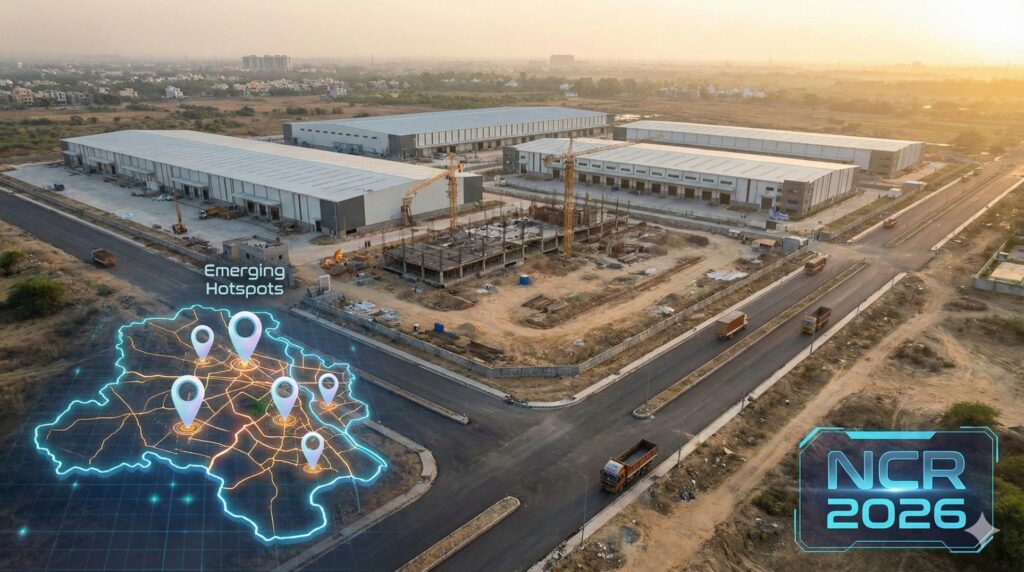
The National Capital Region (NCR) has been one of India’s strongest warehousing and logistics hubs, accelerated by the e-commerce boom, the expansion of 3PL players, rising consumption, and the continuous push for industrial corridor development. As we move into 2026, the warehousing landscape of NCR is undergoing a major shift driven by improvements in connectivity, favourable land policies, and rising corporate demand for large contiguous parcels.
Developers, investors, and occupiers are all evaluating the next wave of emerging warehousing hotspots—areas that offer not just land but long-term strategic advantage. This blog explores the most promising locations for 2026 and why they are gaining traction.
1. Sohna–Taoru Belt (South Gurugram): The Fastest Growing Warehousing Cluster
The stretch connecting Sohna, Taoru, KMP Expressway, and Nuh Road has quickly emerged as the most preferred zone for Grade-A warehousing.
Why it is emerging:
- Direct access to KMP Expressway, enabling seamless movement across Haryana, Rajasthan, Punjab, and Delhi.
- Large land parcels available for aggregation at competitive pricing compared to Gurugram.
- Increasing interest from e-commerce, FMCG, and cold-chain players.
- Rapid infrastructure upgrades including the Delhi–Mumbai Industrial Corridor (DMIC) touchpoints.
Who is evaluating the belt:
- 3PLs
- Food and beverage distribution companies
- E-commerce mid-mile hubs
Its affordability and connectivity make Sohna–Taoru the most promising hotspot for 2026.
2. Bhiwadi–Tapukara–Neemrana Cluster (Rajasthan Side of NCR)
This long-established industrial belt is undergoing a new phase of warehousing expansion.
Reasons for rapid growth:
- Proximity to DMIC and dedicated freight routes.
- Availability of industrial-zoned land and standard factory buildings (SFBs).
- Strong labour availability.
- Attractive pricing compared to Haryana NCR.
Why it matters in 2026:
Demand is rising from automotive, engineering, heavy machinery, and electronics manufacturing companies shifting towards this belt due to favourable policies and lower operational costs.
3. Faridabad–Palwal Logistics Belt
The expansion of the Delhi–Mumbai Expressway has transformed this region.
Key growth drivers:
- New logistic parks being planned along the expressway.
- Strong positioning for Delhi, Noida, and Ghaziabad last-mile deliveries.
- Availability of large-scale agricultural land suitable for aggregation.
- Increasing traction among 3PL, courier, and distribution operators.
Palwal, with its connectivity to both NH19 and KMP, is set to become one of the biggest warehousing land hotspots during 2026.
4. Greater Noida West – Ecotech – Dadri Belt
This region is booming due to strong demand from e-commerce and consumer-goods companies.
What makes it attractive:
- Proximity to Eastern Peripheral Expressway (EPE).
- Excellent access to Delhi, Ghaziabad, Bulandshahr, and Western UP.
- Several logistics parks and industrial clusters already operational.
- Growing interest from electronics, retail, and online grocery players.
With Noida’s infrastructure development continuing rapidly, this cluster is expected to remain among the top 3 warehousing hotspots next year.
5. Kharkhoda – Bahadurgarh – Kundli Belt (Western NCR)
This region is emerging as a future-ready logistics zone due to its location along the Western Peripheral Expressway.
Growth triggers:
- HSIDC’s plan for large industrial townships in Kharkhoda.
- Demand for large contiguous land parcels from MNCs.
- Strategic access to Delhi and Punjab/Haryana belt.
Developers seeking long-term warehousing investments are heavily focusing on Kharkhoda for 2026 expansions.
6. Jewar–Yamuna Expressway Logistics Zone
The Noida International Airport (Jewar) is the biggest catalyst for the transformation of this belt.
Why it is booming:
- Massive demand expected from aviation-linked logistics, perishables, and express cargo.
- DMIC influence and multiple logistics parks announced.
- Strong support from UP Government policies.
- Excellent connectivity to NCR and Western UP.
From 2026 onward, this corridor is expected to become one of the fastest-growing warehousing districts of NCR.
Key Trends Shaping NCR Warehousing Demand in 2026
- Shift from small scattered warehouses to large Grade-A fulfilment centers.
- Rising demand for pre-aggregated land banks over fragmented plots.
- Increased focus on compliance-ready land and regulatory-clear corridors.
- Growth of cold storage and temperature-controlled warehousing.
- Increased developer interest in built-to-suit (BTS) facilities.
Conclusion
NCR’s warehousing demand continues to evolve, with developers and corporates looking beyond traditional hubs like Gurugram and Noida. Emerging corridors such as Sohna–Taoru, Faridabad–Palwal, Bhiwadi–Neemrana, Kharkhoda, and Jewar are set to dominate 2026 due to their connectivity, policy support, and availability of large land parcels.
For land buyers, aggregators, and warehousing developers, understanding these hotspots early offers a strategic advantage as competition and pricing increase steadily moving into 2026.
