Demystifying Real Estate Approvals in India: A Step-by-Step Guide for Developers
Demystifying Real Estate Approvals in India: A Step-by-Step Guide for Developers
Whether you’re developing a housing project, warehouse, institutional facility, or industrial park, one thing is certain—real estate approvals in India are complex. Missing or delaying even a single approval can lead to penalties, stop-work orders, or project shutdowns.
This guide breaks down the most important real estate approvals you need, step by step, so your project stays compliant, on time, and investment-worthy.
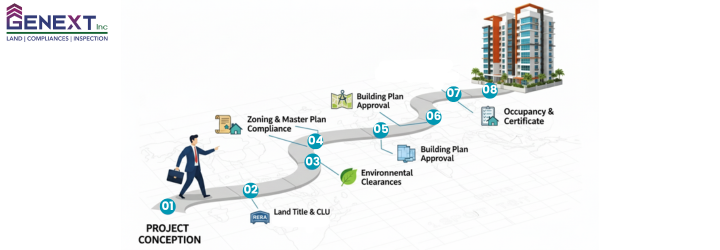
🔹 Step 1: Land Title and CLU (Change of Land Use)
Before anything else, ensure:
- Clear land title with proper ownership records
- Encumbrance-free status
- CLU approval from the Town & Country Planning Department (especially when converting agricultural/residential land for industrial or commercial use)
📍 Why it matters: Without CLU, construction may be declared illegal—even if other approvals are in place.
🔹 Step 2: Zoning & Master Plan Compliance
Check the zoning category of your land as per the city’s master plan. It must align with your intended use—residential, commercial, institutional, or industrial.
📍 Why it matters: Incompatible zoning leads to rejection of your building or layout plan.
🔹 Step 3: Building Plan Approval
Submit your architectural drawings, FAR calculations, and layout to the local development authority for approval. Include:
- Site plan
- Floor-wise layouts
- Parking areas
- Fire safety features
📍 Why it matters: This is the official nod to begin construction.
🔹 Step 4: Environmental Clearances (if applicable)
For larger projects or those near eco-sensitive zones, an Environmental Impact Assessment (EIA) and clearance from the State or Central Environmental Authority may be mandatory.
📍 Why it matters: Skipping this can result in cancellation of your license or litigation from environmental bodies.
🔹 Step 5: Fire Safety and NOC
Obtain a No Objection Certificate (NOC) from the Fire Department, based on your building design, exit strategy, and equipment layout.
📍 Why it matters: Mandatory for occupancy certification and worker/public safety.
🔹 Step 6: RERA Registration (for residential/commercial projects)
If your project involves selling units, flats, or plots to customers, registration under the Real Estate (Regulation and Development) Act (RERA) is compulsory.
📍 Why it matters: Builds buyer trust and legal protection; non-compliance can attract heavy penalties.
🔹 Step 7: Occupancy and Completion Certificate
Once construction is done, apply for:
- Completion Certificate (CC) – confirms the structure follows approved plans
- Occupancy Certificate (OC) – confirms the building is fit for use
📍 Why it matters: Essential to get utilities like water, electricity, and for legal possession.
Final Thought
The real estate approval process isn’t just a legal formality—it’s a strategic part of risk mitigation and investor confidence.
Understanding each step and preparing proactively helps developers:
- Launch faster
- Avoid legal hurdles
- Gain institutional investor trust
- Deliver possession smoothly
Partnering with a compliance expert can simplify this entire journey.
