What Makes a Land Parcel Suitable for Industrial Development?
Industrial land suitability depends on more than just land availability and cost; it also depends on the project’s specific requirements. Although a parcel might seem like it’s a good deal in writing, it could have connectivity, land use, utilities, environmental, or approval issues. Companies need to conduct a feasibility study of industrial land before buying or developing it to ensure that the land is suitable for their intended activities.
The characteristics that determine whether or not a block of land can be developed for industry.
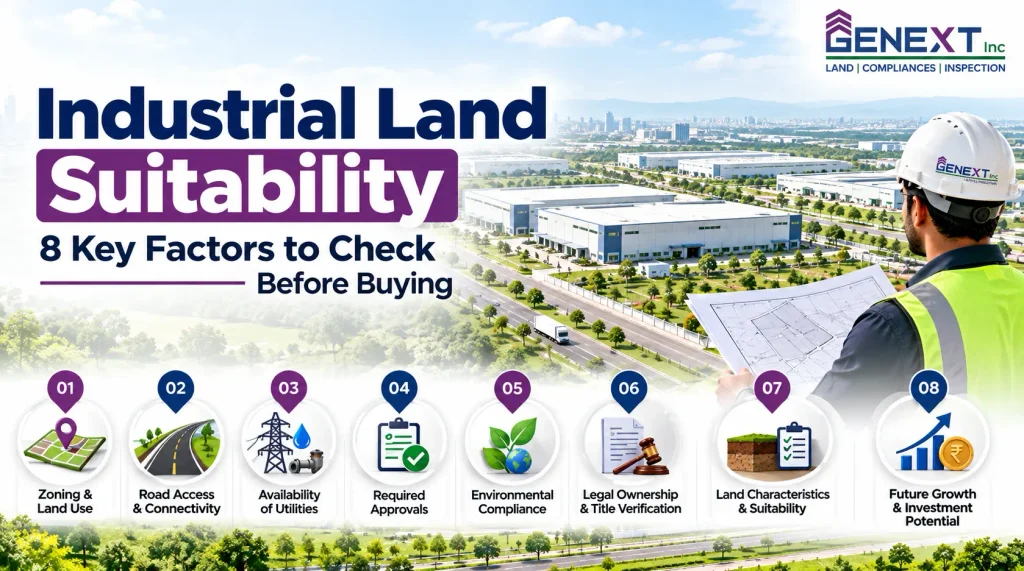
1. Key Factors Affecting Industrial Land Suitability: Land Use and Zoning
The first is to ascertain whether there is a legal right to land for the proposed industrial use. Whether manufacturing, warehousing, logistics or other industrial activities are allowed, is decided by land use regulations and zoning.
Before committing to a parcel, businesses should check applicable master plan, zoning, development plan and land use. Where a change of land use (CLU) or other permission is deemed necessary, the feasibility, process and timeframe should be evaluated prior to this.
2. Industrial Land Suitability and Road Connectivity
The efficient movement of goods is crucial for the functioning of the industries. Businesses should choose a parcel with easy access to major roads, highways, and logistics routes.
Proper connectivity can cut down the movement time and transportation expenses, as well as ease the movement of raw materials, finished products, staff and heavy vehicles. The actual road approach is also of importance. Access may be poor even if a site is near a highway, due to the roads being narrow, access limited or there may be insufficient turning room for commercial vehicles.
Understanding how infrastructure affects land value is equally important when evaluating a site. Read our guide on how infrastructure-led growth influences industrial land investment decisions to learn how connectivity and infrastructure development can influence industrial land investment.
3. Industrial Land Suitability and Essential Infrastructure
Reliable infrastructure is essential to any industry. Prior to purchasing land, businesses should determine the available and capacity of electrical, water supply, drain, sewerage, telecommunication, and other essential services.
The demand for electricity is to be calculated based on the proposed project. Likewise, a business should establish if there is sufficient water and drainage system or if they need to create extra infrastructure.
Project costs can be greatly influenced by on-site utility costs.
4. Industrial Land Suitability: Plot Size, Shape and Terrain
The parcel should have the physical features of the proposed development. A good industrial site must have sufficient land for buildings, production areas, storage, parking, internal roads, loading and unloading as well as utilities and setbacks.
The shape of the plot is also important. Even if the total land area is adequate, an irregularly shaped parcel may poorly facilitate the site planning.
Businesses should also evaluate the site’s topography and ground conditions. Development costs and construction considerations may be affected by slope, drainage, soil characteristics and flood hazards.
5. Environmental and Regulatory Considerations
Environmental regulations apply to industrial projects, depending on the nature, size, location and possible impact of the project. It is important for businesses to find out what environmental conditions apply before they invest in the land.
The assessment may encompass areas in close proximity to the development, which are sensitive to the environment; water bodies; protected areas; pollution control requirements; waste management provisions and permissions relevant to the proposed activity.
Knowing these needs at an early stage in a project can save from expensive shock during project planning.
6. Availability of Approvals & Development Feasibility
The suitability of a land parcel should be assessed in addition to its physical suitability, on the basis of its approval feasibility. Depending on the project and location, businesses may need land use, building plan, fire safety, pollution control, utility, access, and other development approvals.
It is important for businesses to create an approval checklist for the specific project and not presume that every industrial plot goes through the same process.
7. Location and Surrounding Development
Industrial land may be unsuitable over the long-term, depending on the character of the surrounding area. The presence of suppliers, customers, labour, logistics hubs, markets and supporting industries offers enhanced operational efficiency.
Proximity to the use of neighbouring land and planned infrastructure developments should also be considered. Future roads, industrial corridors, logistics facilities, and urban development can influence accessibility and property value.
8. Clear Ownership and Land Records
Before buying industrial land, it is crucial to conduct legal due diligence. Businesses should verify ownership and title documents, land records, encumbrances, existing charges, litigation, acquisition notices, access rights, and other relevant legal issues.
Don’t assume a parcel is project ready just because it is in Seller’s possession or looks like it would be a good project. Ensuring that legal verification is in order helps minimize chances of disputes and delays.
Conclusion
The suitability of an industrial land parcel is defined by the ability to obtain approvals, environmental considerations, physical suitability, legal usability, good connectivity and adequate serviceability.
Cheap may not necessarily be cheap. Before deciding to acquire a land, the business should consider its overall development costs, infrastructure needs, approval process, connectivity, legal status, and future viability.
With a proper site assessment and structured due diligence, businesses can choose sites that will enable a smoother development and sustainable industrial activities.
For more insights on industrial land, real estate development, and regulatory compliance, follow Genext Inc. on LinkedIn for professional updates and industry information.
